
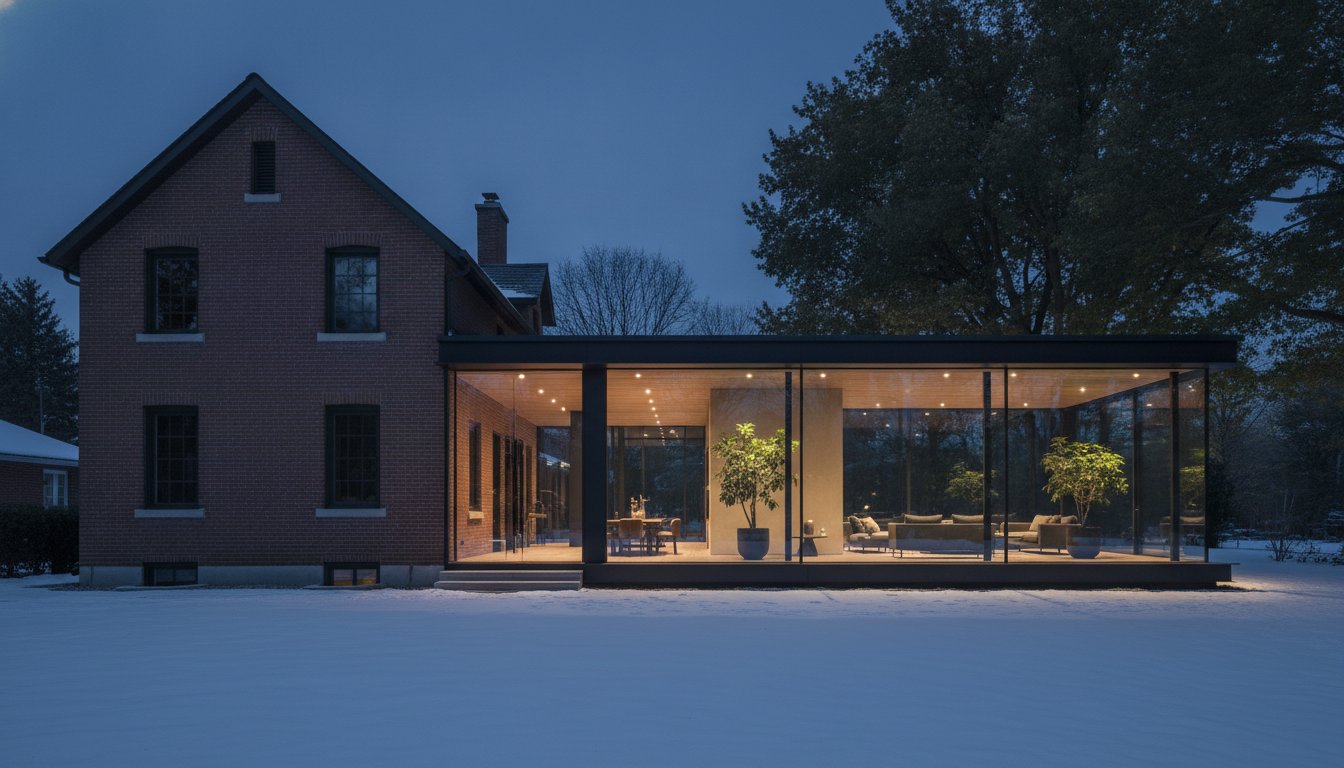
What if the key to your ideal lifestyle isn’t found in a new postal code, but hidden within your existing footprint? As property values remain high and inventory remains tight in 2026, many homeowners find themselves at a crossroads, weighing the pros and cons of home additions vs moving to accommodate a growing family or new professional needs. You likely feel the pull of needing more space, yet the thought of navigating Canada’s steep land transfer taxes and the emotional weight of leaving a curated neighbourhood feels like a heavy price to pay. It is a complex decision that requires more than just a cursory glance at market listings.
We understand that your residence is both a sanctuary and a significant financial asset. This guide provides a sophisticated analysis of whether to expand your current residence or relocate, ensuring you realize the highest possible value for your investment. We will explore a clear financial framework for this choice, examine the bespoke potential of a custom addition, and discuss how to minimize lifestyle disruption during a transformation. Our persistent dedication to architectural excellence ensures you have the clarity needed to decide if your future belongs in a new house or a reimagined version of the one you already love.
Key Takeaways
- Identify the significant financial impact of land transfer taxes and real estate commissions that often make relocation less efficient than reinvesting in your current property.
- Discover how to evaluate the pros and cons of home additions vs moving by comparing cost-per-square-foot metrics against long-term equity gains in established neighbourhoods.
- Learn why the 2026 housing market favours homeowners who leverage architectural design to realize bespoke living spaces rather than settling for the compromises of a pre-existing house.
- Understand the strategic advantage of an integrated design-build model in minimizing lifestyle disruption and ensuring a transparent, ethical transformation of your residence.
- Gain a clear financial framework to determine if your specific property holds the untapped potential to support your evolving lifestyle and investment goals.
The Modern Dilemma: Understanding the Pros and Cons of Home Additions vs Moving
The decision to stay or go is rarely just about square footage. It is a calculation of value, legacy, and lifestyle. Homeowners today face a unique challenge: their current residence feels restrictive, but the financial friction of relocating is at an all-time high. Weighing the pros and cons of home additions vs moving requires a deep understanding of the hidden costs that erode your investment. When you move, you’re essentially paying a premium for someone else’s vision while losing significant capital to non-recoverable expenses like land transfer taxes and real estate commissions. These transaction costs can easily exceed ten percent of a home’s value, representing money that never returns to your pocket.
By 2026, market conditions have shifted the advantage toward those who maximize their existing property. High land values mean your lot is likely your most valuable asset. Relocating often means buying back into the same market at a higher price point, whereas a strategic addition allows you to capture that appreciation without the “sunk cost” trap of a move. Understanding Home Improvement as a vehicle for wealth preservation is essential; it transforms your current residence into a bespoke sanctuary tailored precisely to your future. Our architectural design team identifies structural potential to deliver lasting financial value, ensuring your investment remains grounded in your own equity.
When is your home a candidate for expansion?
Not every house is built for growth. Assessing the “bones” of your structure is the first step in determining structural viability. We look at foundation depth and load-bearing capacities to see if the building can support a second storey. Beyond the physical, we evaluate lot size and local zoning bylaws for setback requirements. Often, the strongest candidate for an addition is a home in a neighbourhood you simply cannot bear to leave. If your current location offers the schools, parks, and community you value, expanding is the logical path forward.
The 2026 Canadian real estate context
Current inventory levels remain low, which significantly influences the “buy vs build” decision. With 30-year fixed mortgage rates hovering between 6.47% and 6.61%, many homeowners find mortgage portability more attractive than securing a new, potentially higher-interest loan for a relocation. Custom home additions have emerged as a preferred wealth-building strategy because they allow you to create the exact space you need without the uncertainty of a bidding war. You aren’t just adding a room; you’re engineering equity in a stable, familiar market.
The Strategic Case for Home Additions: Customizing Your Future
Choosing to expand your residence is an act of creative sovereignty. Unlike purchasing a pre-built home, where you often inherit someone else’s aesthetic limitations and functional compromises, an addition grants you absolute authority over your environment. When evaluating the pros and cons of home additions vs moving, the financial trajectory of your equity is paramount. Targeted expansions often yield a superior return on investment because they eliminate the massive transaction fees associated with selling and buying. You are reinvesting your capital directly into your own asset rather than losing it to the friction of the real estate market.
Staying in place also preserves the intangible assets of your life. You keep your children in their preferred schools, maintain deep-rooted social ties, and protect the emotional capital you’ve invested in your neighbourhood. The true distinction of a successful expansion lies in the architectural cohesion of the final product. Our integrated architectural design and project management model ensures that new structures flow seamlessly from the original house, creating a unified masterpiece rather than a disjointed afterthought. This methodical approach mirrors our commitment to superior creative achievements and enduring professional bonds.
Types of high-impact additions
A second-storey addition is a transformative choice for bungalows, effectively doubling your square footage while preserving your precious outdoor yard space. Alternatively, rear extensions serve as the perfect canvas for open-concept luxury kitchens and expansive Great Rooms that serve as the heart of the home. For those seeking personal rejuvenation, a bespoke primary suite can be designed as a private sanctuary. These projects focus on high-value transformations that align with your long-term lifestyle goals.
Managing the “Construction Zone” reality
The fear of living in a construction site often deters homeowners, but professional project management mitigates this friction. We utilize phased construction strategies to keep your home functional and habitable for as long as possible. There is also a profound psychological reward in witnessing your vision take shape day by day. This sense of progress reinforces your commitment to your future. Our persistent dedication to a clean, organized site ensures that the journey toward your new space is as refined as the final result.
The Reality of Moving: A Fresh Start or a Financial Burden?
Moving offers the seductive promise of an immediate solution. You envision walking into a finished residence that aligns with your current lifestyle without the wait of a construction schedule. This “clean slate” appeal is powerful, especially when your current home feels like it is bursting at the seams. However, a sophisticated analysis of the pros and cons of home additions vs moving reveals that this fresh start often comes with a staggering price tag. The reality of the 2026 market is that relocation is frequently more of a capital drain than a value-add. Most homeowners find themselves trapped in the “Renovation Gap,” where a newly purchased home still requires major renovations to meet their specific standards of luxury and function.
Selling a property in a shifting landscape carries inherent risks. You might sell in a dip and be forced to buy at a peak, eroding the equity you’ve spent years building. Beyond market timing, the sheer friction of the move itself is a significant financial burden. Between real estate commissions and the logistical costs of relocating high-value items, the capital lost to the process is capital that could have been reinvested into your own land. Our role as a visionary partner is to help you see past the temporary allure of a new listing to the long-term stability of your current investment.
The Canadian closing cost audit
In Canada, the financial exit from one property and entry into another is heavily taxed. Land transfer taxes on a luxury purchase represent a massive, non-recoverable expense. When you factor in legal fees, staging costs, and professional movers, the total transaction can easily consume 6% to 10% of a home’s value. Research indicates that for a property valued at $2 million, transaction costs alone can range from $120,000 to $200,000. Local moves under 100 miles cost between $800 and $2,000 on average, but hidden fees for fuel surcharges and specialty item handling can quickly inflate the final bill.
Emotional and social considerations of relocating
Relocating involves a profound social cost that is rarely captured on a balance sheet. Starting over in a new community or school district can be an exhausting process for every family member. Competitive bidding environments often lead to “Buyer’s Remorse,” where the pressure to secure a house results in overlooking hidden functional flaws. A home that looks perfect on a listing site may reveal structural or layout issues that only become apparent after you move in, leading to the very frustration you sought to escape.
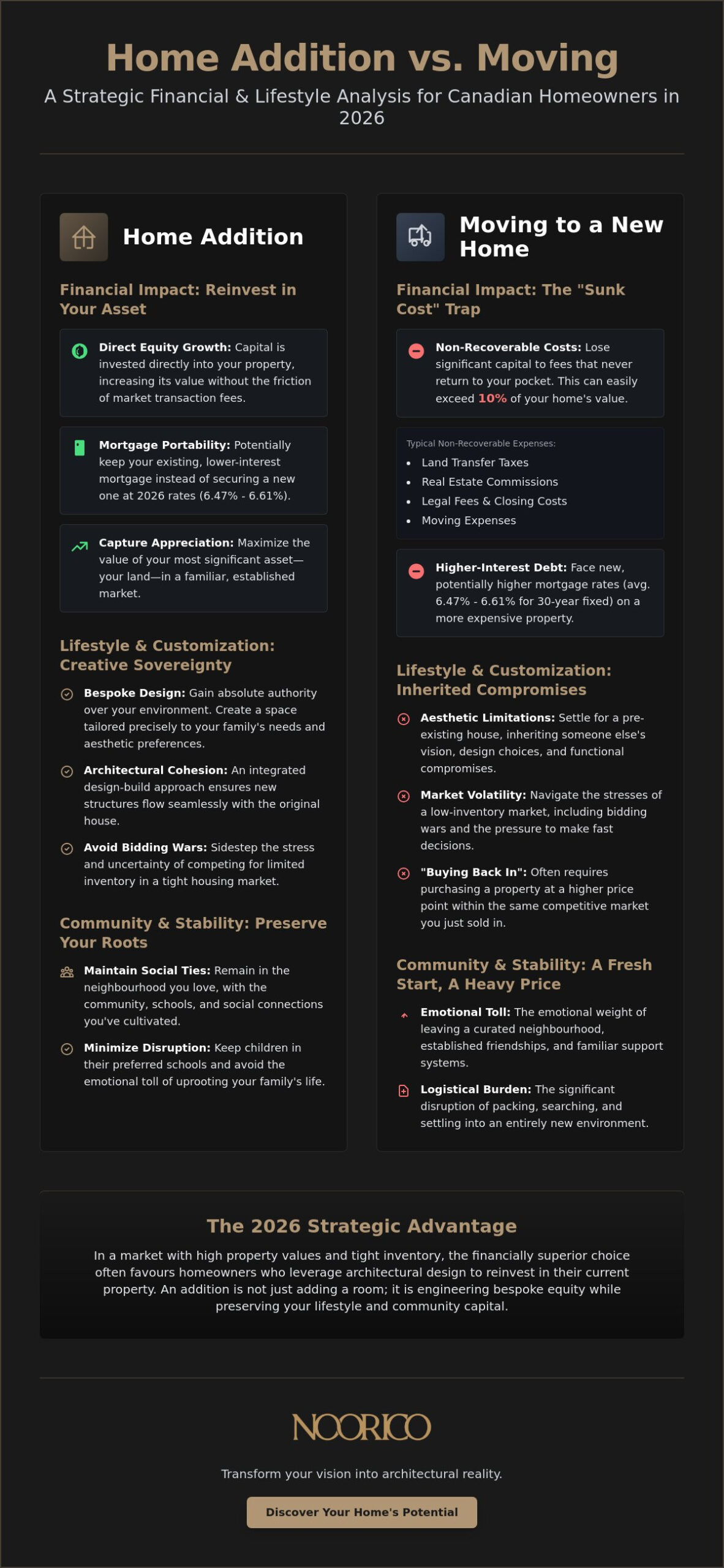
The Financial and Lifestyle Audit: A Side-by-Side Comparison
Resolving the modern dilemma of space requires a rigorous audit of both your financial trajectory and your daily lived experience. When you evaluate the pros and cons of home additions vs moving, you must look beyond the surface price and examine the cost-per-square-foot efficiency. In the 2026 market, purchasing a new residence in a premier neighbourhood often involves paying a significant market premium that exceeds the actual value of the structure. Conversely, a ground-level addition typically costs between $150 and $350 per square foot, allowing you to build equity directly into your existing asset. This approach ensures that every dollar spent is an investment in your own property rather than a payment toward a seller’s profit margin.
The timeline of each path also deserves a sophisticated comparison. While a major addition requires a dedicated design and permit phase, searching for a bespoke home in a low-inventory market can often take just as long, if not longer. Choosing to stay allows you to integrate 2026 sustainability standards into your current structure, such as high-efficiency insulation and advanced climate control systems, which many older “move-in ready” homes lack. Our persistent dedication to project management ensures that your build remains on schedule, transforming the uncertainty of a move into the structured reality of an upgrade. To begin your journey, we invite you to request a professional architectural consultation to assess your property’s untapped potential.
Investment vs. Expense: Where does your money go?
An addition functions as a capital injection into your primary asset, whereas moving costs are largely comprised of non-recoverable service fees. When you pay real estate commissions and land transfer taxes, that capital is permanently removed from your net worth. Equity retention in the Canadian real estate market represents the preservation of your primary capital by avoiding the non-recoverable taxation and commission structures triggered by a property transfer. By building up or out, you are essentially “buying” space at cost rather than at retail market value.
Lifestyle disruption vs. Lifestyle upgrade
The duration of a construction project is often shorter than the total time required to find, purchase, move into, and settle into a new neighbourhood. A custom addition allows your home to evolve alongside your family’s changing requirements without the social friction of relocation. Our architectural design process ensures your addition never looks like an afterthought; instead, it becomes a seamless extension of your original vision. This methodical evolution preserves the character of your home while elevating it to a new standard of luxury and functional elegance.
The NOORICO Approach: Transforming Your Vision into Architectural Reality
NOORICO serves as a multi-disciplinary guide for homeowners navigating the complex intersections of industry, finance, and execution. We unify architectural design with project management to deliver a seamless journey from the initial concept to the final, refined structure. This integrated model eliminates the traditional friction of major home additions, providing a single point of accountability that protects the integrity of your vision. When you evaluate the pros and cons of home additions vs moving, the certainty of a professionally managed build often clarifies the path toward reinvesting in your current property. By aligning your aesthetic desires with structural feasibility, we ensure your residence evolves into its most sophisticated form.
Sophisticated homeowners choose our firm to realize their most ambitious luxury residential expansions because they value the quiet confidence of an established partner. We balance the practical grit of site execution with the sophisticated elegance of high-end design, ensuring every project meets a superlative standard of distinction. Our commitment to ethical pillars and deep-seated reliability reassures clients that their significant investments are in safe, principled hands. This trust-based approach is a hallmark of our longevity and our persistent dedication to the enduring professional bonds we build through every transformation. We don’t merely build spaces; we engineer future equity and lifestyle stability.
The Visionary Partner advantage
We integrate interior design with structural engineering to create a cohesive result that feels like a natural evolution of your home. Our team manages the navigation of complex building permits with professional oversight, removing the administrative burden from your shoulders. This strategic intersection of industry knowledge and creative foresight ensures that every addition adds both aesthetic elegance and significant financial value. By overseeing every detail of the project management process, we maintain a focus on quality and precision that is often lost in fragmented construction models.
Taking the next step in your home’s evolution
Realizing your property’s hidden potential begins with a clear, logical plan tailored to your unique requirements. We invite you to schedule a consultation to explore how a custom addition can transform your daily life and secure your financial future. To see the standard of excellence we bring to every project, you may explore our guide on home additions GTA to view our portfolio of luxury transformations. Our persistent dedication to the final craft ensures that your home remains a sanctuary of high-end design and superior creative achievement for decades to come.
Realizing Your Home’s Untapped Potential
Deciding between a new postal code and a reimagined floor plan is a defining moment for your family’s future and your financial legacy. We’ve examined the pros and cons of home additions vs moving, revealing that the most sustainable path to luxury often lies within your current property’s footprint. Relocation drains capital through non-recoverable transaction fees, while a strategic expansion reinvests that same capital into a bespoke asset tailored precisely to your lifestyle. You don’t have to settle for a pre-existing layout when you can engineer a space that evolves with you.
Our firm brings over 25 years of established expertise in custom residential builds to every transformation. We utilize an integrated multi-disciplinary team of architects, designers, and project managers to ensure your vision is realized with absolute precision. With a persistent dedication to delivering superior creative achievements, we eliminate the friction of complex construction, allowing you to remain anchored in the neighbourhood you love. Partner with NOORICO to realize your home’s full potential through bespoke architectural design and construction.
Your ideal living space doesn’t have to be a search; it can be a creation. Trust in a partner who values your investment as much as you do and remains dedicated to the enduring professional bonds we build.
Frequently Asked Questions
Is it cheaper to build an addition or move to a larger house in 2026?
Building an addition is generally the more cost-effective choice when you consider the massive non-recoverable transaction fees associated with relocating. In 2026, the total cost of moving can consume up to 10% of a property’s value through real estate commissions and taxes. By choosing an addition, you reinvest that capital directly into your own equity rather than paying a market premium for a different residence.
What are the most common types of home additions that add the most value?
Second-story additions and expansive rear kitchen extensions typically yield the highest return on investment for sophisticated homeowners. These projects significantly increase your usable square footage without sacrificing valuable outdoor yard space. Incorporating high-end architectural design into a new primary suite also adds a layer of luxury that appeals to future buyers while immediately elevating your daily lifestyle and comfort.
How much does Land Transfer Tax impact the cost of moving in Canada?
Land Transfer Tax represents a significant financial hurdle for Canadian homeowners, as it is a non-recoverable expense paid at the time of purchase. On a luxury property, this tax alone can reach tens of thousands of dollars. When weighing the pros and cons of home additions vs moving, this sunk cost often makes a custom expansion the more logical path for preserving your net worth.
Can I stay in my home during a major second-story addition?
It is technically possible to remain in your residence during a second-story addition, provided your project management team utilizes a phased construction strategy. We focus on maintaining the functionality of your ground floor for as long as possible. However, many clients choose to vacate temporarily during the most intensive structural phases to avoid the noise and dust associated with a major architectural transformation.
How long does the architectural design and permit process take for an addition?
The timeline for architectural design and permit approval typically ranges from a few weeks for minor projects to several months for larger expansions. Securing building permits requires professional oversight to ensure all local zoning requirements are met. While this phase requires patience, it is a critical step in ensuring your addition is structurally sound and legally compliant with municipal standards.
What is the “Renovation Gap” when buying a pre-owned home?
The “Renovation Gap” refers to the significant capital most homeowners must spend after purchasing a pre-owned house to make it meet their personal standards. Even a “move-in ready” home often requires updates to the kitchen, bathrooms, or floor plan to feel truly bespoke. This secondary investment often makes the total cost of moving far higher than the initial purchase price suggests.
Does a home addition always require a new foundation?
Ground-level additions always require a new foundation to support the new structure, whereas second-story additions rely on the existing foundation. If you are building up, we must assess your current “bones” to ensure they can handle the additional load. In some cases, structural reinforcement of the existing walls and foundation is necessary to maintain the safety and integrity of your home.
How do I know if my local zoning allows for a significant home expansion?
Determining your expansion potential involves a thorough review of local zoning bylaws, including setback requirements and maximum lot coverage limits. Every municipality has specific regulations that dictate how close you can build to your property lines and how much of your lot can be covered by a structure. Our team provides professional oversight during this evaluation, identifying the hidden potential of your land.