
A new home warranty is not a safety net designed for your comfort; it is the absolute minimum legal floor required to ensure a structure remains habitable. Most homeowners realize that while a warranty provides a foundation of security, the fear of latent structural defects appearing years later often persists. Having new home warranty canada explained with absolute precision is the first step toward transforming that anxiety into a legacy of enduring quality.
We understand that your custom build or major renovation represents a significant investment in your future. You deserve a partner who views these mandatory frameworks as a baseline for excellence rather than a ceiling for performance. This guide clarifies the complex 1-2-5-10 and 2-5-10 year frameworks across the country, including critical 2026 updates like Ontario’s $150,000 deposit protection and Alberta’s $265,000 coverage limits. You will gain the knowledge required to maintain your warranty through diligent care and the confidence to select a builder who prioritizes accountability over mere compliance.
Key Takeaways
- Master the 1-2-5-10 and 2-5-10 frameworks to recognize the difference between minor aesthetic adjustments and critical structural or mechanical delivery systems.
- Navigate the evolving provincial landscape with new home warranty canada explained, ensuring you understand the latest 2026 regulatory updates from Ontario to British Columbia.
- Identify your specific responsibilities regarding seasonal maintenance and the “Duty to Mitigate” to prevent avoidable damage and preserve your legal coverage.
- Learn to distinguish between your builder’s immediate performance obligations and the long-term oversight provided by third-party warranty corporations.
- Realize why a visionary partner integrates architectural precision into the build process to exceed mandatory industry standards and minimize future maintenance.
What is a New Home Warranty and Why Does it Matter in 2026?
A new home warranty is a legally mandated protection plan designed to safeguard homeowners against construction defects and structural failures. It functions as a structured commitment from the builder, overseen by a third-party regulator, to ensure that the physical integrity of your residence matches the promises made during the architectural design phase. Having new home warranty canada explained is essential because, in 2026, the distinction between a builder’s immediate service obligation and the long-term oversight of a provincial authority has never been more critical. As severe weather events drive more rigorous building envelope standards, this protection ensures that your luxury property remains a secure asset. This framework separates the practical grit of site management from the high-level accountability required to protect a significant residential investment.
The Legal Framework of Residential Construction
Provincial legislation creates a mandatory environment where builders must participate in recognized warranty programs to operate legally. While many homeowners use the terms interchangeably, a warranty is a performance guarantee for specific components, whereas insurance typically covers accidental damage. Provincial oversight reinforces builder accountability, ensuring that your home’s structural integrity meets the highest ethical standards. For those embarking on custom home building projects, the registration procedures are more nuanced than standard subdivision builds. In Ontario, for instance, Tarion requires buyers of new freehold homes to register their purchase within 45 days of signing to qualify for full deposit protection. This regulatory oversight provides a structured path for dispute resolution, ensuring that ethical standards are upheld throughout the construction lifecycle. These registrations act as a baseline for quality, providing the quiet confidence that your visionary partner is held to the highest industry benchmarks.
Protecting Your Financial Legacy
Beyond physical protection, a valid warranty is a cornerstone of your financial strategy and long-term legacy. Lenders often require proof of third-party coverage before releasing construction financing or approving a mortgage, as it mitigates the risk of structural failure. This document serves as a badge of quality that enhances property value during a future sale, as the coverage remains attached to the home rather than the owner. Pre-possession is the timeframe between signing a construction contract and the day you officially move into your new residence. By securing this protection early, you preserve your capital and ensure that your investment is recognized as a premium asset by the wider market. A transferable warranty communicates to future buyers that the home was built with persistent dedication to technical precision and superior design. Professional project management secures your financial interests, ensuring that every architectural detail contributes to a lasting resale advantage.
The Standard Coverage Framework: 1-2-5-10 and 2-5-10 Explained
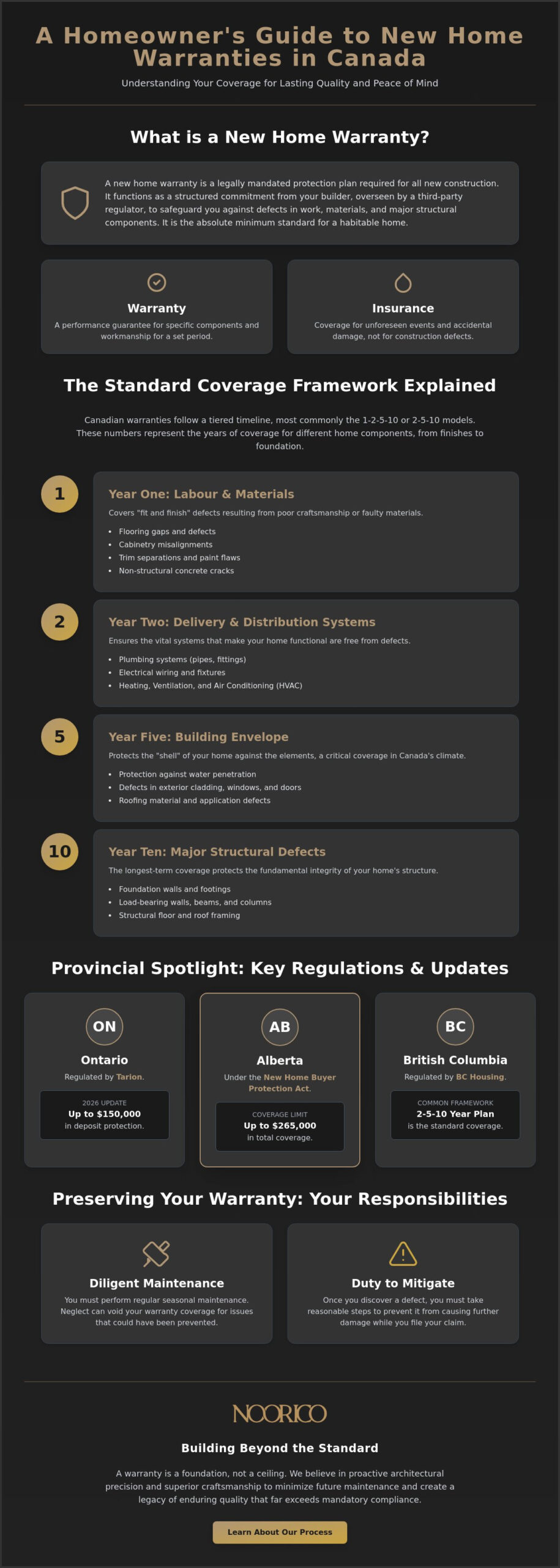
The Canadian warranty landscape relies on a tiered timeline, typically structured as either a 1-2-5-10 or a 2-5-10 framework. These numbers represent the duration of coverage for specific categories of construction, moving from the superficial to the foundational. Having new home warranty canada explained in this graduated manner ensures you understand that while your interior paint is protected for twelve months, the structural load-bearing components remain secured for a full decade. This methodical approach mirrors the operational precision required to execute a high-end custom build where every detail must withstand the test of time. By categorizing protection into these distinct phases, regulators provide a structured path for homeowners to address defects before they escalate into significant financial liabilities.
Labour and Materials: The First 24 Months
The initial year of occupancy focuses on “fit and finish,” covering defects in materials and labour such as flooring gaps, cabinetry misalignments, or trim separations. Because Canadian climates demand extreme resilience, HVAC systems are scrutinized during this period to ensure they can sustain interior comfort during -30°C winters. Under Alberta’s New Home Buyer Protection Act and similar provincial mandates, the second year expands this focus to delivery systems, including plumbing and electrical distribution. It also covers water penetration through the building’s exterior. Custom home owners should prioritize a comprehensive “Year-End” inspection to document any shifts in the residence before the first tier of coverage expires. This proactive step ensures that the practical grit of daily living hasn’t revealed hidden flaws in the home’s sophisticated systems. It’s a period where persistent dedication to maintenance is required to preserve your long-term warranty rights.
Building Envelope and Structural Integrity
As the residence enters its third year, the focus shifts toward the building envelope and major structural elements. The building envelope acts as the exterior shell, and moisture management remains the primary concern for any luxury investment. Protection for the envelope typically lasts five years, shielding the home against water penetration that could compromise high-value interior finishes. For those undertaking home additions gta, it’s vital to realize how new structures integrate with existing warranties to maintain a seamless shield of protection. The final ten-year tier covers major structural defects, including foundations, framing, and roof trusses. This long-term security allows you to focus on the aspirational aspects of your home, knowing the core structure is backed by an uncompromising commitment to quality. If you are planning a project that requires this level of architectural precision, choosing a partner who views these standards as a minimum is the most effective way to ensure lasting reliability.
Navigating the Provincial Landscape: A National Overview
While the tiered framework of protection offers a national blueprint, the execution of these safeguards remains a provincial responsibility. Having new home warranty canada explained through a regional lens is vital for investors managing properties across different jurisdictions. In Ontario, the system is governed by Tarion, a non-profit corporation that has overseen more than 2.6 million homes since 1976. As of 2026, freehold deposit protection in Ontario has reached $150,000, reflecting the significant capital requirements of high-end custom builds. This robust regulatory environment provides a structured path for accountability, ensuring that the sophisticated design of your residence is matched by a equally sophisticated legal shield.
Western provinces like British Columbia and Alberta utilize insurance-based models where private providers compete under provincial oversight. In Alberta, the New Home Buyer Protection Act mandates a minimum coverage limit of $265,000 for single-family homes. Quebec’s system, managed by the Garantie de construction résidentielle (GCR), has implemented a rigorous inspection program for the 2025-2029 period. This program requires three mandatory site visits during construction to verify that the practical grit of the build matches the architectural design. In the Atlantic provinces, programs like the Atlantic Home Warranty provide coverage limits typically reaching $70,000. Despite these regional variations, the National Building Code provides a consistent technical backbone that ensures every Canadian home meets a high baseline of safety and performance.
Regional Nuances in Claim Filing
Deadlines for filing claims vary significantly by province. Ontario homeowners now benefit from an updated 40-day initial submission period and a permanent 10-day grace period at the end of the first year. These timelines are strictly enforced to ensure that defects are addressed before they compromise the building envelope. Provincial regulators act as mediators, providing a trust-based approach to dispute resolution between owners and builders. You should always verify a builder’s standing through regional registries to confirm they possess a valid licence and a history of persistent dedication to their warranty obligations. This verification ensures your visionary partner is recognized by authorities as an ethical and established professional.
Warranty for Major Renovations and Additions
A major renovation or home addition can trigger “new home” warranty requirements if the project meets the legal threshold for substantial reconstruction. In Canadian building law, substantial reconstruction typically occurs when a project involves replacing a vast majority of the existing structure, leaving only the foundation or a small portion of the original walls. When your project reaches this level of transformation, it may be eligible for the same 1-2-5-10 or 2-5-10 protections as a ground-up build. Protecting your investment during these large-scale residential transformations requires a project management team that understands these legal intersections. This foresight ensures that your expanded residence is not only a creative achievement but also a fully protected asset under provincial law.
Homeowner Responsibilities: Maintenance to Preserve Your Warranty
Homeownership in the luxury sector requires more than just an appreciation for high-end design; it demands active stewardship of the physical structure. While the builder provides the foundation of quality, you must uphold your end of the legal contract through the “Duty to Mitigate.” This legal principle requires that you take immediate, reasonable action to prevent further damage once a defect is discovered. If a minor plumbing leak is ignored for weeks, the resulting mould or structural rot may be excluded from coverage due to owner inaction. Having new home warranty canada explained involves recognizing that your protection is contingent upon reasonable care and persistent dedication to the home’s upkeep.
Maintaining a meticulous maintenance log is essential for substantiating future claims and protecting your financial legacy. This record should document seasonal tasks such as clearing gutters to prevent ice damming and replacing HVAC filters to ensure mechanical longevity. Common exclusions often include “acts of God” like unprecedented weather events or owner neglect such as failing to drain exterior hose bibs before the first freeze. By treating your residence as a high-performance asset, you ensure that the warranty remains a reliable safety net rather than a voided promise. This methodical approach to care mirrors the project management precision used during the construction phase.
The Critical First-Year Walkthrough
The Pre-Delivery Inspection (PDI) is the most important meeting of the build because it establishes the official baseline for the home’s condition at the moment of possession. During this walkthrough, you must create a comprehensive deficiency list that distinguishes between minor aesthetic settling and genuine structural concerns. While hairline cracks in drywall often result from the natural curing of lumber, wider gaps in the foundation or significant floor slopes require immediate professional assessment. This initial documentation acts as the primary evidence for your one-year “fit and finish” claims. Capturing these details early ensures that the transition from construction to occupancy is handled with the same sophistication as the initial design.
Managing Indoor Humidity and Air Quality
Canadian humidity cycles present a unique challenge to premium materials like wide-plank hardwood flooring and bespoke millwork. Rapid shifts between humid summers and dry winters can cause significant expansion and contraction if interior environments are not managed with precision. Heat Recovery Ventilator (HRV) systems are vital tools that protect your building envelope by regulating fresh air intake without compromising the home’s thermal efficiency. Improper ventilation is a leading cause of denied warranty claims, as excess interior moisture can lead to window degradation and wall damage that builders are not legally responsible for. For those seeking a visionary partner in custom home building, understanding these technical nuances is the most effective way to protect your architectural investment. Professional guidance ensures that your home’s systems are balanced to preserve both comfort and warranty eligibility.
Beyond the Minimum: Why NOORICO Elevates the Building Standard
A mandatory warranty is a legal floor, not a ceiling of achievement. While having new home warranty canada explained provides you with a necessary baseline of protection, a visionary partner recognizes that true residential excellence requires a higher standard of execution. We believe that a luxury residence should be defined by its longevity and technical precision rather than just its aesthetic appeal. By integrating high-performance construction techniques with sophisticated design, we reduce the likelihood of future claims and ensure that your investment remains a source of pride for decades. Our project management process utilizes rigorous oversight to identify and resolve potential issues long before they become warranty concerns. This proactive approach transforms the building process from a series of compliance checks into a pursuit of superior creative achievements.
The link between architectural precision and reduced long-term maintenance is found in the persistent dedication to the details that remain hidden behind the drywall. Superior moisture management, advanced thermal bridging solutions, and high-efficiency delivery systems aren’t just technical requirements; they’re the components of a home built to endure. When a build is managed with quiet confidence and deep-seated reliability, the need for third-party intervention becomes a distant contingency rather than a looming anxiety. We view the building process as a steady, structured progression toward a final product that surpasses industry benchmarks. This commitment to quality ensures that your significant investment is protected by more than just a certificate, but by the very methods used to create it.
The Design-Build Advantage
The intersection of architectural design and custom home building is where the most significant risks to structural integrity are mitigated. By utilizing an integrated design-build model, we ensure that every creative choice is backed by the practical grit of engineering reality. This synergy reduces the risk of structural errors and ensures that complex architectural features are executed with uncompromising accuracy. Our project management team maintains a steady, structured flow throughout the build, ensuring that code compliance is treated as a baseline for every home addition or major renovation. We craft bespoke spaces that are intentionally built to outlast the standard ten-year structural warranty, providing you with the quiet confidence that your home’s beauty is matched by its enduring stability.
Your Partner in Residential Excellence
Our commitment to your project is grounded in ethical pillars and deep-seated accountability. We don’t just provide a service; we act as a multi-disciplinary guide through the complexities of Canadian building regulations and financial execution. This trust-based approach ensures that you are fully informed at every stage, from the initial architectural drawings to the final walkthrough. We take a palpable sense of pride in our longevity and the professional bonds we build with our clients, ensuring that your significant investment is in safe, principled hands. By choosing a partner dedicated to persistent dedication in every detail, you secure a home that transcends the minimum requirements of provincial law. Discover how NOORICO manages luxury custom builds and renovations to create a lasting legacy of quality and design.
Securing Your Architectural Legacy
Your residence is a testament to your vision and a significant pillar of your financial future. Having new home warranty canada explained ensures you possess the technical knowledge to navigate provincial regulations and uphold your maintenance responsibilities with precision. You now recognize that while the 1-2-5-10 and 2-5-10 frameworks provide a baseline of security, the true protection of your investment lies in the quality of the initial build and the persistent dedication of your project management team. A home built with architectural foresight is a home built to endure far beyond the mandatory legal requirements.
With over 25 years of integrated design and construction expertise, we specialize in high-end residential transformations that exceed industry standards. Our team provides comprehensive project management from concept to completion, ensuring that every architectural detail is executed with uncompromising accuracy. We invite you to Begin your custom home journey with NOORICO’s expert team. By choosing a partner who values ethical accountability and superior craftsmanship, you transform a legal requirement into a lasting achievement of design and stability. Your journey toward an elevated residential experience begins with a commitment to excellence that outlasts the decade.
Frequently Asked Questions
Is a new home warranty mandatory for all custom builds in Canada?
Mandatory coverage depends on your specific province. In Ontario, Alberta, British Columbia, and Quebec, provincial legislation requires all new residential construction to be registered with a third-party provider. In Manitoba and Atlantic Canada, coverage is not legally mandated by the government but remains a standard benchmark for professional builders. Having new home warranty canada explained helps owners realize that even where not required, third-party oversight is often essential for securing construction financing and mortgages.
Does the warranty cover cosmetic issues like paint chips or small cracks?
Cosmetic issues are typically covered during the first-year “fit and finish” tier of the warranty framework. This includes interior paint, flooring gaps, and cabinetry defects resulting from improper materials or labour. However, hairline cracks in drywall are often attributed to the natural curing of building materials and may not be considered defects unless they exceed specific width thresholds. You should document these items during the Pre-Delivery Inspection to ensure they are addressed before the initial coverage period expires.
What happens to the warranty if my builder goes out of business?
Your protection remains secure through the third-party warranty provider, such as Tarion in Ontario or the GCR in Quebec. These organizations act as a backstop, fulfilling the builder’s obligations and managing repairs if the original contractor is unable to do so. This structure provides the quiet confidence that your significant investment is protected by a regulatory body rather than a single entity. The provider manages the claim process and oversees the necessary repairs to maintain the residence’s integrity.
How much does a new home warranty cost for the homeowner?
The cost of the warranty is typically integrated into the total contract price of the home rather than paid as a separate fee by the owner. Builders pay an enrollment fee to the provincial provider based on the home’s value or type. While you don’t usually pay this fee as a direct transaction, it is a critical component of the project’s financial structure. This fee secures the third-party oversight and deposit protection required to safeguard your capital throughout the construction lifecycle.
Can I file a warranty claim for issues found during a major renovation?
Warranty claims for renovations are applicable only if the project qualifies as a “substantial reconstruction” under provincial law. This typically occurs when a majority of the existing structure is replaced, effectively creating a new residence. For standard major renovations, you should ensure your contract includes a specific builder’s warranty for materials and labour. Understanding new home warranty canada explained ensures you can distinguish between mandatory provincial coverage and private contractual guarantees for your expansion project.
How long do I have to file a claim after discovering a defect?
You must act immediately upon discovering a defect to fulfill your “Duty to Mitigate” and prevent further damage. Specific submission windows vary by province; for example, Ontario utilizes a 40-day initial period and a permanent 10-day grace period at the end of the first year. Failure to report issues within these strict timelines can result in a loss of coverage. Maintaining a detailed maintenance log and documenting all findings with photographs ensures your claims are substantiated and processed efficiently.
What is the difference between a builder’s warranty and home insurance?
A new home warranty is a performance guarantee against construction defects, whereas home insurance protects against accidental damage and external events. The warranty covers structural failures, water penetration, and mechanical delivery systems resulting from improper labour or materials. Conversely, insurance addresses losses from fire, theft, or severe weather events. Both are essential components of a sophisticated risk management strategy, providing a comprehensive shield for your architectural investment and personal assets against diverse forms of risk.
Are appliances covered under the new home warranty program?
Appliances are generally covered by the manufacturer’s warranty rather than the provincial new home program. However, as of October 5, 2026, Quebec has implemented a new legal warranty of good working order for specific goods like refrigerators and washing machines. In most other provinces, the builder’s responsibility is limited to the proper installation of these units. You should register all appliances with manufacturers immediately upon possession to ensure their specific service agreements remain valid and your investment is fully protected.