

A custom home represents the pinnacle of your personal and financial legacy, yet many homeowners entrust this vision to a builder based on little more than a pleasant conversation and a basic quote. You realize that your investment deserves more than a surface-level check; it requires a deep, uncompromising audit of professional grit and financial stability. It’s natural to feel anxious about how to vet a general contractor while managing the complexities of provincial insurance requirements and the 2025 National Building Code updates.
This guide will teach you to master a sophisticated process of auditing credentials and creative alignment to safeguard your residential assets. By following this definitive Canadian framework, you’ll gain the quiet confidence that your project is in principled hands. We will explore the essential layers of modern due diligence, from the specific financial markers that distinguish a visionary partner to the technical standards that ensure structural excellence. You’ll move from a state of uncertainty to one of strategic foresight, ensuring your future home is built on a foundation of accountability and precision.
Key Takeaways
- Shift your perspective from a simple hire to a strategic audit of professional standards, treating your custom build as a primary residential investment.
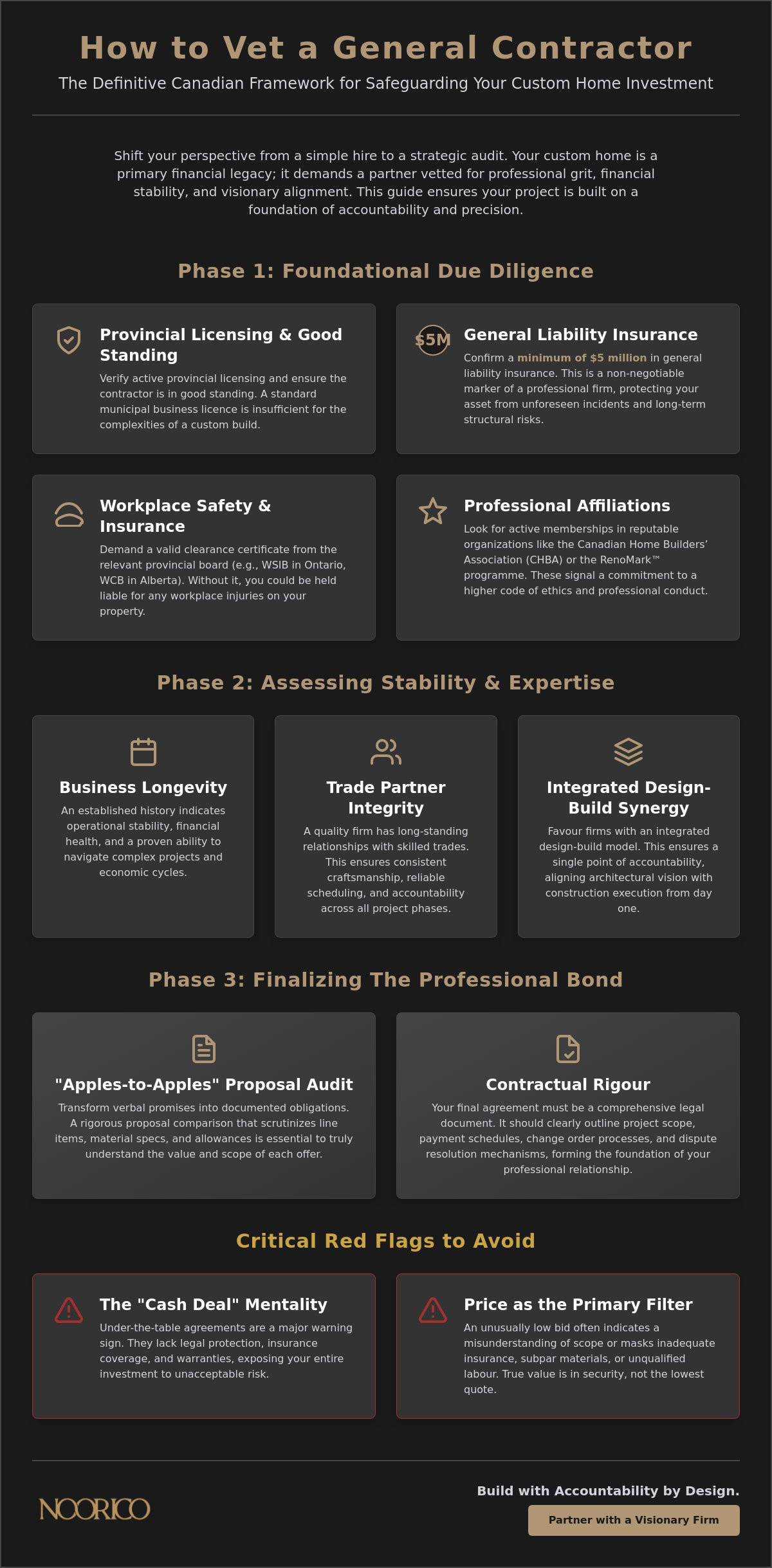
- Verify essential Canadian compliance markers, including provincial licensing and a minimum of $5 million in general liability insurance, to ensure long-term structural security.
- Master how to vet a general contractor by evaluating their operational stability, business longevity, and the integrity of their long-standing trade partner relationships.
- Understand the sophisticated advantages of an integrated design-build approach to ensure your architectural vision and interior design are executed with uncompromising precision.
- Finalize your professional bond using a rigorous “apples-to-apples” proposal comparison that transforms every verbal promise into a documented contractual obligation.
The Philosophy of Vetting: Why Professional Standards Matter
Vetting is not a bureaucratic exercise. It’s a comprehensive risk-management strategy designed to protect your most significant asset. When you begin the process of learning how to vet a general contractor, you’re looking for more than a set of tools; you’re seeking a visionary partner who understands the sophisticated intersection of architectural integrity and financial accountability. This audit ensures your primary investment remains secure throughout the complex lifecycle of a custom build.
The distinction between a transactional contractor and an integrated professional firm is profound. A transactional builder often focuses on the immediate task, prioritizing speed over the enduring quality of the final product. Conversely, an integrated firm provides a multi-disciplinary approach, managing every facet of the project with an uncompromising dedication to your long-term vision. When understanding the role of a general contractor, you must realize they are the lead orchestrator of a multi-million dollar symphony of trades, materials, and permits. In the Canadian construction landscape, we define this as “Accountability by Design,” a framework where transparency is the default and excellence is the only acceptable outcome.
Many homeowners mistakenly use price as their primary filter, but in high-end custom builds, price is the least reliable metric. A low bid frequently masks a lack of insurance, inadequate trade relationships, or a failure to account for the complexity of modern building codes. A professional firm justifies its fees through project security, ensuring that your investment is protected by robust insurance and ethical business practices. True value is found in the intersection of strategic industry knowledge and creative foresight, not in the lowest estimate on the table.
The High Stakes of Custom Residential Construction
Major renovations and new builds are complex organisms with thousands of moving parts. Poor vetting doesn’t just lead to delays; it can result in structural failures that devalue your property for decades. A visionary partner protects your property value by ensuring every detail meets the highest standards of distinction. This level of oversight is essential for any luxury residential expansion where the goal is a seamless blend of old and new, requiring an uncompromising dedication to the final product.
Moving Beyond the “Cash Deal” Mentality
The Canadian Home Builders’ Association consistently warns against under-the-table agreements. These “cash deals” lack the legal protections and insurance coverage necessary for large-scale projects. Professionalism requires a trust-based approach grounded in ethical pillars. By choosing a firm that prioritizes documented accountability, you ensure that your multi-year construction relationship is built on a foundation of mutual respect and legal certainty. Understanding how to vet a general contractor means realizing that project security and insurance coverage are the true hallmarks of a mastered craft.
Credentials and Compliance: The Essential Canadian Checklist
Securing your residential investment begins with a rigorous verification of legal standing. While the philosophy of vetting establishes the partnership’s tone, the credentials provide the structural safety net for your capital. Understanding how to vet a general contractor requires a granular look at provincial requirements, as a standard municipal business licence is rarely sufficient for the complexities of a custom build or a major renovation.
A professional firm maintains active standing with provincial safety and insurance boards, such as Ontario’s WSIB or Alberta’s WCB. For 2026, the Ontario WSIB has set the average premium rate at $1.23 per $100 of insurable payroll, with a maximum earnings ceiling of $121,700. Verifying a contractor’s clearance certificate is vital; without it, you could be held liable for any workplace injuries occurring on your property. This level of diligence extends to professional memberships. Affiliations with the Canadian Home Builders’ Association (CHBA) or the RenoMark program signal a commitment to a code of ethics and a higher standard of service that goes beyond mere compliance.
Verifying Legal and Regulatory Standing
Your audit should start with provincial registries to confirm the firm holds all necessary active licences. In provinces like Quebec, this involves the RBQ, while in British Columbia, new home builders must be licensed by BC Housing. A visionary partner operates from a permanent physical office centre rather than a mobile-only setup, suggesting an established business infrastructure capable of supporting a multi-year project. Checking municipal records for building permit history also reveals if the contractor has a consistent record of following local regulations and consumer rights in home renovation.
Insurance and Liability: Protecting Your Investment
Standard home insurance is insufficient for the risks of active construction. You must confirm the firm carries a minimum of $5,000,000 in commercial general liability (CGL) insurance. This protects against third-party property damage or bodily injury. Always request a current Certificate of Insurance (COI) that names you as “additionally insured” for the duration of the build. For significant investments, you might also consider a project management partner who can oversee the role of bonding, ensuring that performance and payment obligations are met even in unforeseen circumstances. This methodical approach to liability ensures that your project is grounded in security and organizational order.
Operational and Financial Auditing: Assessing Firm Stability
A builder’s credentials provide the legal framework for your project, but their operational stability determines its daily success. When you investigate how to vet a general contractor, you must look beyond the glossy portfolio to the engine of the business itself. Evaluating business longevity is a critical pillar of this audit. A firm with over 25 years of experience hasn’t just survived; they’ve mastered the complex intersections of industry and execution through multiple economic cycles. This longevity suggests a seasoned professional who has refined their craft and remains dedicated to the enduring professional bonds they have built.
Financial transparency is equally vital for protecting your residential investment. A stable firm demonstrates the ability to manage large-scale cash flows and project fees without relying on your next deposit to pay for a previous client’s materials. This organizational order extends to their trade partner relationships. A builder who maintains long-standing ties with premium subcontractors, such as specialized plumbers and electricians, signals deep-seated reliability. You should observe how a builder treats their trades; prompt payments and clear scheduling are the hallmarks of a multi-disciplinary guide who respects the expertise of their team.
The “Site Visit” audit offers a tangible window into a firm’s professional grit. When visiting a current, active construction project, look for more than just progress. A clean, organized job site with clearly defined safety protocols reflects a culture of precision and accountability. If the site is chaotic, the management of your budget and timeline will likely follow suit. This physical evidence moves the narrative from abstract values to practical implementation, allowing you to see their philosophy in action.
The Reference Check: Going Beyond the Surface
Standard references often provide a curated view of success. To gain a deeper understanding of how to vet a general contractor, ask past clients specific questions about budget adherence and communication during high-stress phases. Don’t stop there. Requesting a reference from a current trade partner can be even more revealing. A trade partner who has worked with a builder for a decade can confirm if the firm operates with the ethical pillars and financial stability required for a multi-year custom build.
Project Management and Communication Flow
Modern residential construction requires a sophisticated reporting structure to ensure your peace of mind. Evaluate their use of technology for cost tracking and progress updates. A visionary partner identifies potential bottlenecks, states the corrective action, and ensures the financial benefit of staying on schedule. This steady, structured rhythm mirrors the operational process itself, providing a predictable and reassuring flow for the homeowner. Assessing the grit of their on-site supervision ensures that your architectural vision is never compromised by a lack of daily oversight.
Creative and Cultural Fit: Vetting for Design-Build Synergy
Vetting for technical compliance is the floor; vetting for creative synergy is the ceiling. When you explore how to vet a general contractor for a high-end residential investment, you must evaluate their ability to translate abstract inspiration into tangible elegance. A transactional builder might follow a blueprint, but a visionary partner elevates the design through an integrated approach that bridges the gap between architectural intent and physical execution. This synergy ensures that your aesthetic goals aren’t lost in the grit of project management.
An integrated design-build model offers a significant advantage for major renovations and custom builds. By housing architectural design, interior design, and project management within a single collaborative ecosystem, the firm eliminates the friction often found between separate entities. This unified structure fosters a trust-based approach where every trade partner is aligned with the final creative achievement. You aren’t just hiring a builder; you are selecting a multi-disciplinary guide who remains dedicated to the enduring professional bonds required to realize a sophisticated home.
Architectural and Interior Design Integration
A professional firm demonstrates creative foresight by identifying potential structural or aesthetic conflicts long before the first shovel hits the ground. During your audit, ask how the builder collaborates with architects to realize complex designs. They should be able to explain their specific action for ensuring a seamless transition from initial concept to final construction. This proactive stance protects your financial benefit by preventing costly mid-project changes. If you are ready to begin your transformation, our team provides architectural and interior design services tailored to your unique lifestyle.
Alignment of Values and Aesthetics
Analyzing a firm’s portfolio reveals their consistency in delivering high-quality finishes and their commitment to distinction. During the discovery phase, a sophisticated expert focuses on your lifestyle and future-building needs, ensuring the project reflects your personal narrative. They should demonstrate a palpable sense of pride in their ability to curate bespoke living spaces that stand the test of time. Bespoke construction is the intersection of strategic knowledge and creative foresight. This alignment of values creates a predictable and reassuring flow, transforming the stress of construction into a journey of shared inspiration and precise implementation.
The Selection Framework: Finalizing Your Professional Bond
Finalizing your professional bond is the ultimate expression of the due diligence you’ve performed throughout this audit. By this stage, you’ve verified credentials and evaluated operational grit; now, you must ensure that every value-driven promise is codified in a legal framework. This final phase of how to vet a general contractor transforms your research into a roadmap for execution. Precision is our standard. A professional firm welcomes this level of scrutiny, as it establishes the ethical pillars and accountability required for a multi-year project.
When comparing proposals, a rigorous “apples-to-apples” method is critical for any luxury residential expansion. You must realize that a lower initial price often signals a lack of strategic foresight or the omission of essential project management fees. A visionary partner provides a transparent breakdown that accounts for the 2025 National Building Code requirements and the high standards of a custom build. This transparency ensures that your residential investment is protected from the anxiety of budget overruns. Trust requires documentation.
Understanding Contract Structures
A detailed “Scope of Work” acts as the primary safeguard against future disputes. Whether you choose a fixed-price model for its financial certainty or a cost-plus structure for its flexibility, the contract must define how change orders and unforeseen site conditions are managed. This structured approach mirrors the operational process itself, providing a predictable and reassuring flow for the homeowner. Every milestone should be clearly documented, stating the specific action, the timeline, and the financial benefit to the project’s momentum. Understanding how to vet a general contractor means ensuring that the contract reflects the grit and honesty of the firm.
Why NOORICO is the Visionary Choice
Choosing Noorico means partnering with a firm that brings 25 years of persistent dedication to the Toronto and GTA market. We aren’t mere service providers; we are a multi-disciplinary group that integrates real estate knowledge, financial strategy, and architectural execution. This holistic perspective ensures that your home is not just a building, but a sophisticated achievement of design. Our longevity in the region serves as a badge of local expertise, grounding your high-level aspirations in a tangible, localized context. We manage the complexity so you can focus on the inspiration. Begin your bespoke journey with a Noorico consultation today.
Building Your Legacy with Strategic Confidence
Mastering the process of how to vet a general contractor transforms a complex residential investment into a predictable journey of creative achievement. You’ve learned that a truly professional audit extends far beyond a simple checklist; it requires a deep dive into financial stability, provincial compliance, and the sophisticated synergy of an integrated design-build team. By prioritizing transparency and accountability, you safeguard your property’s value and ensure your architectural vision is realized with uncompromising precision.
Success in custom construction depends on the intersection of strategic industry knowledge and persistent dedication. With over 25 years of established expertise in the Canadian market, our multi-disciplinary group provides the rigorous project management standards and integrated architectural and interior design services necessary for a seamless transformation. We invite you to partner with NOORICO for your next visionary residential project. Your dream deserves a foundation of quiet confidence and seasoned reliability. Let’s begin building your future with the distinction it deserves.
Frequently Asked Questions
How do I verify if a contractor is properly licensed in Canada?
Verification occurs through provincial regulatory bodies. In British Columbia, you must check the BC Housing registry; in Quebec, the Régie du bâtiment du Québec (RBQ) maintains active records. For Ontario, where licensing is often municipal, you should contact the local building department. A visionary partner will proactively provide their licence numbers, allowing you to confirm their standing and ensure your residential investment is protected by legal compliance and professional standards.
What is the minimum amount of liability insurance a custom home builder should carry?
A professional builder should carry a minimum of $2,000,000 in commercial general liability insurance, though $5,000,000 is the preferred standard for high-end custom builds. This coverage protects against third-party property damage and bodily injury. You must request a current Certificate of Insurance (COI) that names you as additionally insured. This specific action ensures that the financial risks of the construction process remain with the firm, not the homeowner.
Can I hire a general contractor who does not have a physical office?
Hiring a contractor without a permanent physical office is generally discouraged for major residential investments. A physical business centre signifies operational stability and a mastered craft developed over years of industry experience. It provides a tangible location for project management and architectural design meetings. While mobile operations may suit minor repairs, a custom build requires the sophisticated infrastructure and deep-seated reliability that an established office environment provides to its clients.
What happens if a worker gets injured on my property during a renovation?
You may be held personally liable for medical costs and lost wages if a worker is injured and the contractor lacks provincial workers’ compensation coverage. It’s vital to verify active standing with boards like WSIB or WCB before work begins. A professional firm provides a clearance certificate as part of their standard transparency. This protects your capital and ensures that every trade partner on your site is covered by a robust safety net.
How many estimates should I get for a major home addition?
Obtaining three detailed proposals is the industry standard for a major home addition. However, the depth of the audit is more critical than the number of quotes. When learning how to vet a general contractor, focus on an “apples-to-apples” comparison of the scope of work and project management standards. A visionary partner provides a comprehensive breakdown that reflects the true complexity of the build, rather than a vague, low-cost estimate.
What is the RenoMark program and why does it matter for homeowners?
The RenoMark program identifies professional renovators who have agreed to a specific code of ethics and high standards of business conduct. Members must provide a minimum two-year warranty on their work and carry at least $2,000,000 in liability insurance. For homeowners, this affiliation acts as a badge of distinction. It reassures you that the firm is committed to ethical pillars, persistent dedication, and the long-term integrity of your residential assets.
Should I vet the subcontractors that the general contractor plans to hire?
You should audit the strength of the builder’s trade partner relationships rather than vetting every individual subcontractor. Ask how long the firm has worked with their primary electricians and plumbers. Long-term bonds with premium trades signal organizational order and financial stability. A builder who maintains a consistent, high-quality team ensures that your architectural vision is executed with the precision and creative foresight required for a sophisticated custom home.
What are the red flags to watch for when interviewing a builder for a custom home?
Primary red flags include requests for “cash deals,” lack of a permanent business address, and high-pressure sales tactics. If a builder cannot provide a detailed project management schedule or proof of insurance, they lack the professional grit necessary for a custom build. Vague communication regarding how to vet a general contractor or a failure to document promises in writing suggests a transactional approach that could jeopardize your significant residential investment and peace of mind.