
In 2026, the calibre of your builder is as significant to your lender as your personal credit score. While the Bank of Canada has held its policy rate steady at 2.25 percent and the prime rate sits at 4.45 percent, many Canadians find that the true challenge of how to finance a custom home build in canada lies in the intricate dance of progress draws and strict builder qualifications. You likely feel the weight of these complexities, especially when you’re trying to manage potential cost overruns in a market where material prices for copper and aluminum have seen double-digit increases this year.
This authoritative guide provides the clarity you need to move from inspiration to execution with quiet confidence. You will learn how to leverage land equity effectively and utilize the latest 2026 federal incentives, such as the $60,000 RRSP withdrawal limit. We will provide a clear roadmap for securing financing approval, ensuring you understand construction mortgages under the new Build Canada Homes Act. By the end of this article, you will have a sophisticated strategy to find a builder that lenders trust and a budget that remains resilient against inflation.
Key Takeaways
- Discover why a standard residential mortgage is insufficient for bespoke projects and how 2026 lending standards necessitate a more specialized, milestone-based approach.
- Master the mechanics of the progress draw system to ensure your funding is released seamlessly at every critical stage of the construction lifecycle.
- Learn how to finance a custom home build in canada by strategically balancing hard costs, soft costs, and the essential contingency reserves required for financial stability.
- Understand the “Vetted Builder” requirement and why your choice of a professional partner is a primary factor in securing lender approval and minimizing risk.
- Integrate architectural design with financial planning through professional project management to safeguard your investment and maintain a steady construction rhythm.
Navigating the Canadian Custom Build Financial Landscape in 2026
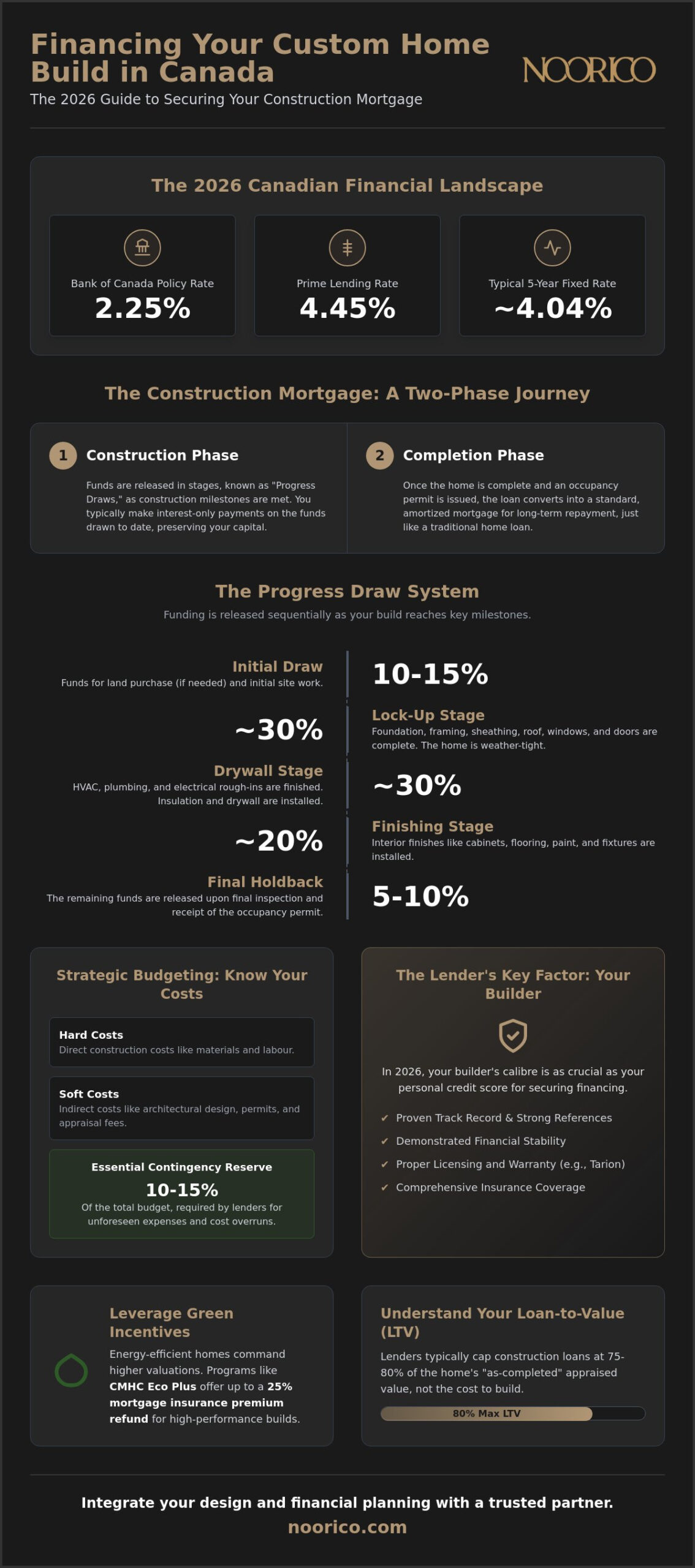
The Canadian financial landscape for residential development has undergone a significant transformation. As of June 2026, the Bank of Canada maintains a policy interest rate of 2.25 percent, while the prime rate remains steady at 4.45 percent. These figures provide a stable foundation, yet the criteria for securing a loan have become increasingly sophisticated. Understanding Mortgages is the first step, but a standard loan is often insufficient for a bespoke project. Traditional lenders require the collateral to exist upfront. For those wondering how to finance a custom home build in canada, the solution is a construction mortgage that releases funds as the structure rises. This specialized instrument bridges the gap between your architectural vision and the finished reality.
Lenders now prioritize the “as-completed” appraisal value over the current state of the land. This projection determines your maximum loan-to-value (LTV) ratio, which is typically capped at 75 to 80 percent of the future home’s worth. Success requires a visionary partner mindset. You aren’t just a borrower; you’re the director of a complex development project. Banks expect a high level of professional grit and a detailed roadmap before they commit capital. They’re looking for deep-seated reliability in your planning and your chosen team.
Custom Builds vs. Major Renovations: Financing Distinctions
Financing paths diverge based on the project’s scope. A renovation typically utilizes a home equity line of credit or a mortgage refinance if the original structure remains largely intact. However, once you cross the threshold of structural replacement, such as a second-storey expansion or a gut renovation where only the foundation remains, lenders transition the file to a construction mortgage. This distinction is vital. A ground-up build requires a more rigorous approval process because the lender’s risk is higher until the roof is on and the building is weather-tight. They’ll scrutinize your builder’s track record with the same intensity they use for your credit score.
The 2026 Economic Context for Canadian Homeowners
The 2026 market rewards foresight and sustainability. While 5-year fixed mortgage rates hover around 4.04 percent, construction phases often involve interest-only payments based on the funds drawn to date. Modern building codes have also shifted appraisal dynamics. High-performance, energy-efficient designs now command higher valuations. Programs like the CMHC Eco Plus offer a 25 percent mortgage insurance premium refund for new builds that meet top-tier efficiency standards. This financial incentive makes “green” builds not just an ethical choice, but a strategic financial one for Canadians. Securing these benefits requires meticulous documentation and a builder who understands the intersection of finance and high-end design.
Understanding Construction Mortgages: Progress Draws and Disbursement Cycles
Securing financing for a bespoke residence differs fundamentally from a traditional home purchase. A construction mortgage is a specialized financial instrument where funds are released in stages based on project milestones rather than as a single lump sum. This structure protects the lender’s capital while providing the cash flow necessary to fuel the build. Understanding how to finance a custom home build in canada requires a deep dive into the “Progress Draw” system, which acts as the financial heartbeat of your project. During the active construction period, you typically manage interest-only payments on the amount currently drawn. This arrangement preserves your liquidity for soft costs and unexpected variations until the project reaches completion.
Once the final occupancy certification is issued, the loan transitions into a permanent, amortized mortgage. This shift marks the end of the high-intensity construction phase and the beginning of your long-term residency. It’s a structured evolution that reflects the growing value of your asset as it transforms from a vacant lot into a sophisticated home.
The Standard Draw Schedule: From Foundation to Finish
Lenders utilize a standardized sequence to release capital, ensuring that the loan-to-value ratio remains within safe parameters. While specific bank policies vary, most schedules follow these four critical stages:
- Stage 1: Land Equity Release. If you already own the land, lenders may allow you to draw up to 65 percent of the lot’s value to initiate the project.
- Stage 2: Foundation and Rough-ins. This release occurs once the foundation is poured and the main structural components are in place.
- Stage 3: Lock-up Stage. Funds are disbursed when the roof is on and the windows and doors are installed, making the structure weather-tight.
- Stage 4: Interior Finishing. The final draw covers the installation of high-end finishes, cabinetry, and flooring prior to occupancy.
The Role of Inspections and Quantity Surveyors
Lenders don’t simply take your word for it. They require third-party verification through progress inspections or reports from a quantity surveyor. These professionals ensure the work matches the value of the requested draw. Consulting resources from the Canadian Home Builders’ Association can help you understand the industry standards these inspectors use to evaluate a project’s completion percentage. Coordination is key. You must align your builder’s schedule with the inspector’s availability to avoid “draw delays” that can stall progress. Expert project management ensures these milestones are met with precision, keeping the financial rhythm of the build in perfect sync with the physical execution on-site.
Strategic Budgeting: Managing Hard Costs, Soft Costs, and Contingency Reserves
Precision in budgeting is the hallmark of a sophisticated expert. When you examine how to finance a custom home build in canada, you must look beyond the obvious labour and material expenses. Hard costs encompass the physical shell, from the structural lumber to the final coat of paint. In early 2026, material volatility remains a significant factor for project management, with copper prices rising 14 percent and aluminum increasing 11 percent quarter-over-quarter. Soft costs are equally vital but often underestimated by those new to the bespoke market. These include professional fees for architectural design, interior styling, and the necessary municipal permits. A rigorous approach to these figures prevents scope creep, ensuring your project stays within the boundaries of your lender’s original approval. Maintaining a contingency reserve of 15 to 20 percent is no longer optional; it’s a requirement for deep-seated reliability in a fluctuating market.
Financing the Design and Planning Phase
The design phase acts as the financial foundation of your bespoke project. While most construction mortgages don’t disburse funds until the physical build begins, the investment in architectural design pays dividends during the appraisal process. A visionary design that maximizes the potential of the site can significantly elevate the projected value of the finished home. This higher appraisal provides more room in your loan-to-value calculations, potentially increasing your total borrowing capacity. Early allocation for interior design and bespoke cabinetry ensures these high-value details are accounted for before the budget is finalized. This proactive planning allows you to move from inspiration to implementation without financial friction.
Land Equity and Acquisition Strategies
Leveraging land equity is a strategic move for the seasoned homeowner. If you’ve already secured a lot, its appraised value can often act as your down payment. This equity-in-lieu approach is a cornerstone of how to finance a custom home build in canada for many clients. However, the type of land matters significantly to your lender. A tear-down in a mature neighbourhood usually comes with existing services, whereas vacant rural land requires substantial investment in infrastructure. Lenders view unserviced land as a higher risk. You must account for the costs of bringing power, water, and waste management to the site before the construction loan is fully realized. Grounding your project in a clear understanding of these site-specific requirements ensures a predictable and reassuring flow for your financing approval.
The Lender’s Perspective: How Your Choice of Builder Influences Approval
Financial institutions view your custom build through the lens of risk management rather than architectural beauty. While you see a future sanctuary, the lender sees a complex series of variables that must be controlled to protect their investment. Understanding how to finance a custom home build in canada requires recognizing that your builder’s reputation is a primary asset in your loan application. In 2026, Canadian banks have significantly tightened their “vetted builder” requirements. They prioritize firms that demonstrate deep-seated reliability, financial stability, and a documented history of finishing projects on time. An established professional acts as a guarantor of the project’s viability, providing the practical grit necessary to navigate municipal hurdles and supply chain shifts.
A common objection among homeowners is the desire to manage the project themselves to save on management fees. However, the owner-builder model often lacks the organizational order required to satisfy modern lending criteria. Most major lenders are increasingly wary of “self-build” projects because they lack the professional accountability that a seasoned firm provides. Without a proven track record, an individual managing a build represents an unpredictable variable. Banks realize that cost overruns are more frequent with inexperienced managers, which can jeopardize the entire financing agreement. Choosing a professional partner isn’t just about construction; it’s a strategic move to ensure your capital remains accessible throughout the project lifecycle.
The Design-Build Advantage for Financing
The integration of architectural design and construction services offers a distinct advantage during the appraisal and approval process. A unified team simplifies the paper trail for lenders, providing a single point of accountability that reduces administrative friction. This model ensures that cost estimating is accurate from the earliest sketches, preventing the mid-project funding shortfalls that often plague fragmented teams. The Design-Build model serves as a comprehensive risk-mitigation strategy for Canadian banks by consolidating architectural oversight and construction execution under a single, accountable entity. By aligning the vision with the budget from day one, you project an image of quiet confidence that reassures your financial partners.
Essential Builder Documentation for Your Loan Application
Lenders crave transparency and certainty. To secure approval, your application must be grounded in concrete evidence of the project’s feasibility. A fixed-price contract is often preferred over cost-plus arrangements in 2026, as it provides a ceiling for the lender’s exposure and protects against the 3 to 4 percent construction inflation currently affecting the Canadian market. You must also provide proof of builder warranties, such as Tarion in Ontario, and comprehensive liability insurance. Modern lenders also appreciate the use of sophisticated project management software, which allows for real-time reporting and clear evidence of milestone completion. NOORICO provides this level of meticulous project management to ensure every financial requirement is met with precision, allowing you to focus on the creative evolution of your home.
Realizing Your Vision: Integrating Design and Finance with NOORICO
The journey toward a bespoke residence is a multi-disciplinary endeavour that requires a master of both creative foresight and financial precision. Determining how to finance a custom home build in canada is only the first step; the second is ensuring that your capital is deployed with the persistent dedication that a premium project demands. NOORICO acts as your visionary partner, bridging the gap between abstract architectural concepts and concrete financial implementation. We provide a steady, structured path that aligns your aesthetic aspirations with the practical grit of Canadian lending standards. By consolidating architectural design, interior styling, and project management under one roof, we eliminate the friction that often disrupts the flow of construction financing.
Our multi-disciplinary approach ensures that every creative decision is grounded in financial reality. We understand that a lender’s trust is built on predictability and transparency. Our team manages the complex intersections of industry and finance, allowing you to move from inspiration to a financed implementation plan with quiet confidence. This methodical process mirrors the operational excellence required to maintain a seamless draw schedule, ensuring that your project remains a safe and principled investment from the initial groundbreaking to the final occupancy.
Bespoke Architectural and Interior Design
Precision in the design phase is the most effective way to maximize your property value and secure favourable loan-to-value ratios. We craft sophisticated plans that realize your unique vision while adhering to your specific financing constraints from day one. This proactive alignment prevents the costly redesigns that can stall a project and alienate lenders. Whether we are designing a new ground-up residence or managing home additions gta, we apply the same level of financial rigour and architectural distinction. Our goal is to create a design that not only inspires but also stands as a robust asset in the eyes of Canadian financial institutions.
Professional Project Management for Peace of Mind
A successful build relies on the persistent dedication of a seasoned professional who understands the mechanics of progress draws and municipal requirements. NOORICO provides comprehensive project management that safeguards your investment throughout the entire build lifecycle. We maintain organizational order by providing transparent construction fees and meticulous budget management, ensuring that every milestone is met with precision. Our role is to act as your sophisticated expert, navigating the technical complexities of the build so that the process remains reassuring and logical. This accountability ensures that your significant investment is in safe hands. Partner with NOORICO to build your custom legacy and transform your visionary goals into a tangible, enduring masterpiece.
Securing Your Custom Legacy with Financial Foresight
Mastering the complexities of how to finance a custom home build in canada requires more than just capital; it demands a fusion of strategic industry knowledge and creative foresight. You’ve learned that success hinges on navigating the progress draw system, balancing a rigorous budget with contingency reserves, and selecting a builder that lenders recognize as a stable partner. These pillars ensure your investment remains protected while your architectural vision takes shape. By grounding your project in these principles, you move from the abstract realm of inspiration to the concrete reality of execution.
NOORICO brings over 25 years of integrated design-build expertise to every project, offering specialized project management designed for high-value residential builds. We act as your multi-disciplinary guide through the technical and financial intersections of the industry. Consult with NOORICO to start your custom build journey and benefit from our persistent dedication to your future home. Your path to a bespoke residence is now clear. With a sophisticated strategy and a trusted partner, your visionary home is well within reach.
Frequently Asked Questions
What is the minimum down payment for a custom home build in Canada?
Canadian lenders typically require a minimum down payment of 20 to 25 percent for a custom build project. This requirement is more stringent than standard residential purchases because the lender’s collateral doesn’t fully exist at the start. Providing a significant down payment demonstrates your financial stability and reduces the bank’s risk during the initial phases of construction. It’s a foundational step in establishing the trust-based relationship required for high-value lending.
Can I use the equity in my current lot to finance the construction?
You can definitely leverage the equity in your current lot to secure your financing. Lenders often treat the appraised value of the land as a portion of your down payment, which is a strategic way to manage how to finance a custom home build in canada. You’ll still need a strong credit score, generally 680 or higher, and a detailed construction plan to satisfy the lender’s requirements for deep-seated reliability.
How do interest rates for construction loans compare to standard mortgages?
Construction interest rates are generally higher than standard mortgage rates because of the increased risk involved. In 2026, while a conventional 5-year fixed rate might hover around 4.04 percent, construction loans often feature interest-only payments during the active building phase. This structure allows you to preserve liquidity for soft costs while the structure rises, only transitioning to a permanent mortgage once the final occupancy permit is issued.
What happens if the construction project goes over budget?
If your project exceeds the budget, you must rely on your contingency reserve, which should be 10 to 20 percent of the total cost. Lenders rarely increase the loan amount once the mortgage is finalized. This is why partnering with a firm that demonstrates persistent dedication to project management is vital. Accurate cost estimating and architectural oversight help prevent scope creep and protect your financial investment from unexpected market fluctuations.
Do Canadian lenders allow for self-managed custom builds in 2026?
Most Canadian lenders are increasingly reluctant to approve self-managed or owner-builder projects in 2026. Banks prefer the security of a vetted builder with established insurance and provincial warranties like Tarion. A professional firm provides the organizational order and accountability that lenders crave. Securing a loan for a self-managed project is difficult because lenders want the assurance that a sophisticated expert is managing the complex construction lifecycle.
How long does the construction mortgage approval process typically take?
The approval process for a construction mortgage typically takes four to eight weeks to complete. This timeline is more extensive than a standard mortgage because the lender must scrutinize your builder’s qualifications and the detailed project budget alongside your personal credit. Providing a comprehensive documentation package from the outset ensures a predictable and reassuring flow, allowing you to move from the design phase to groundbreaking without unnecessary delays.
Is it possible to finance both the land purchase and the build simultaneously?
You can certainly finance both the land acquisition and the construction simultaneously through a single loan. This integrated approach is a common strategy for how to finance a custom home build in canada, as it allows you to secure the site and start the build under one agreement. Coordinating these elements requires a visionary partner who can align the land purchase with the architectural timeline to maximize your borrowing capacity from day one.
What documents do I need from my builder to apply for a construction loan?
You must provide several key documents from your builder, including a fixed-price contract, proof of liability insurance, and provincial warranty registration. Lenders also require a detailed, line-item budget and a full set of architectural plans. These documents provide the transparency and certainty that financial institutions need to approve your loan. Providing this level of detail demonstrates the practical grit and professional standards required for a successful bespoke project.