
What if the perceived safety of a resale home is actually the greatest risk to your long-term wealth and peace of mind? In a market where high-quality inventory remains scarce, many homeowners feel pressured to settle for aging properties that hide costly defects. When you’re evaluating the prospect of building a house vs buying in canada, it’s natural to feel a tension between the dream of a custom masterpiece and the practical anxiety of construction timelines. You likely believe that an existing home offers a faster transition, yet the reality often involves years of disruptive renovations to correct someone else’s design choices.
With the Bank of Canada holding the policy rate at 2.25 percent and new federal GST/HST rebates offering up to $50,000 in savings, the financial landscape of 2026 has shifted significantly. This guide provides the clarity you need to determine whether a bespoke build or a strategic purchase aligns with your aspirations. We analyze regional cost trends and the impact of the 2025 National Building Code to ensure your next move is a seamless and sophisticated success that honours your long-term vision.
Key Takeaways
- Recognize why the widening quality gap in the resale market is driving sophisticated homeowners toward custom construction to secure enduring value.
- Explore how bespoke architectural design eliminates the functional compromises of older properties while future-proofing your home’s layout.
- Compare the total cost of ownership when building a house vs buying in canada, accounting for equity growth and the avoidance of future renovation expenses.
- Demystify the complexities of the Committee of Adjustment and zoning bylaws to ensure a predictable and organized path toward your move-in day.
- Learn how the design-build partnership serves as a visionary guide, offering a single point of accountability from the initial concept to the final, high-end finish.
The Canadian Real Estate Landscape in 2026: Why the Build vs. Buy Debate Matters
The decision regarding building a house vs buying in canada has evolved from a simple financial calculation into a strategic lifestyle choice. As we move through 2026, the Canadian real estate market presents a stark contrast between the scarcity of high-quality resale inventory and the increasing accessibility of custom construction. Many homeowners find themselves trapped in a cycle of compromise. The convenience of an existing property is quickly overshadowed by the realization that the home doesn’t truly serve their family’s evolving needs. This has sparked a profound psychological shift. Canadians are moving away from the “starter home” mentality, choosing instead to invest in enduring, “forever” assets that reflect their personal aesthetic and functional requirements from day one.
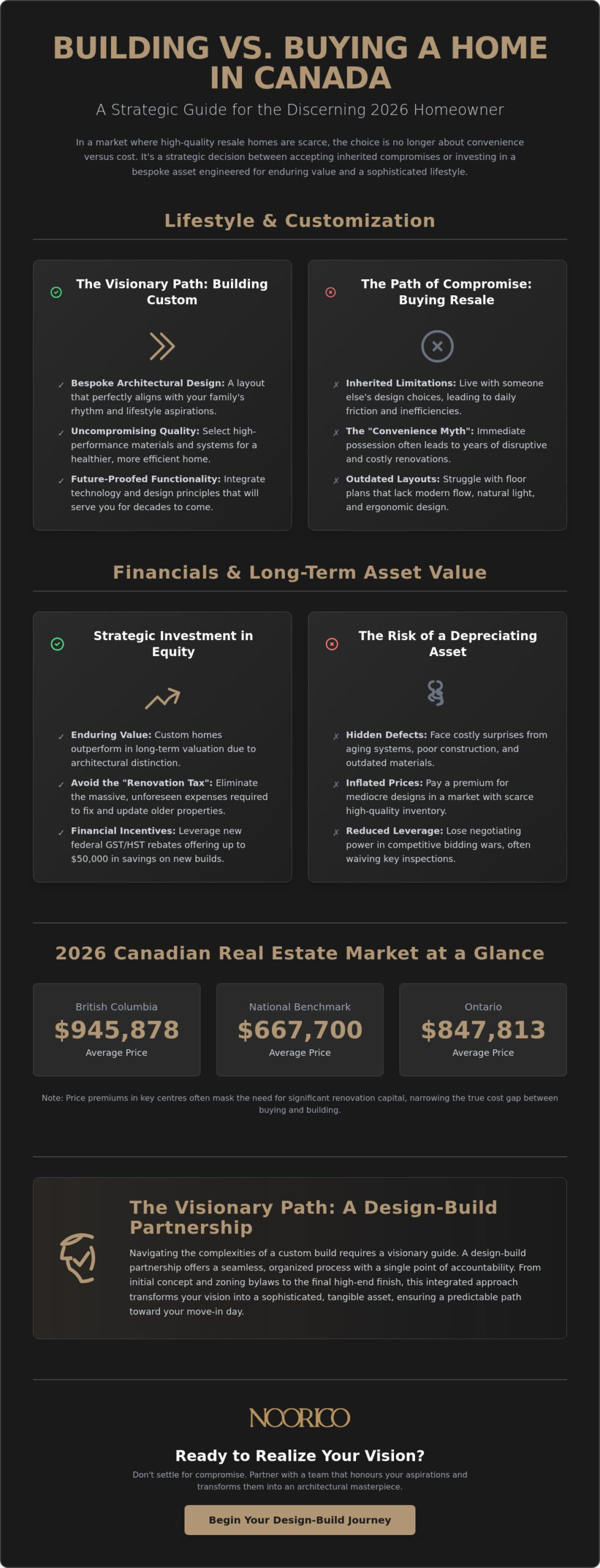
Choosing between these two paths requires a clear understanding of your timeline and risk tolerance. The resale route offers immediate possession but often leads to a fragmented living experience as you attempt to retrofit an old structure. Conversely, a custom build allows you to oversee every detail, ensuring the final product is a cohesive, high-performance asset. The process of constructing a house represents an investment in precision, allowing you to bypass the “renovation tax” that plagues older properties. In 2026, the value proposition has shifted. With federal GST/HST rebates now available for new builds up to $1 million, the financial gap between buying and building has narrowed, making the custom route more viable than ever.
Inventory Challenges in the Current Market
Finding a move-in ready luxury home has become an exercise in frustration across major Canadian centres. While the national benchmark price sat at $667,700 in May 2026, high-demand regions like British Columbia and Ontario see averages of $945,878 and $847,813 respectively. Buyers often pay a premium for properties that still require significant capital to address outdated systems or hidden defects. Market scarcity impacts your power in several ways:
- Reduced leverage during the inspection and negotiation phases.
- Inflated prices for mediocre designs that lack modern efficiency.
- Competitive bidding wars on properties that still require major renovations to meet 2025 National Building Code standards.
The Rise of the Bespoke Residential Asset
Custom homes are increasingly outperforming generic builds in long-term valuation because they possess architectural distinction that generic subdivisions lack. A bespoke environment isn’t just about aesthetics; it’s about strategic future-proofing. By integrating superior materials and personalized layouts, you create a property that maintains its allure regardless of market fluctuations. Transitioning from a standard floor plan to a custom masterpiece ensures your living space is a direct extension of your lifestyle aspirations. This visionary approach transforms a simple residence into a sophisticated, multi-generational asset.
Customization vs. Convenience: Analyzing the Lifestyle Impact
The “Convenience Myth” suggests that purchasing an existing home is the path of least resistance. However, for many discerning homeowners, this path leads to immediate compromise. When you analyze building a house vs buying in canada, you must weigh the superficial ease of a transaction against the daily friction of a layout that doesn’t align with your family’s rhythm. Buying for today often means inheriting yesterday’s limitations. Building for tomorrow allows you to integrate a design-first philosophy where every square foot serves a specific purpose, from ergonomic kitchen flows to natural light optimization that enhances mental clarity.
Customization acts as a sophisticated tool for health. By selecting high-performance materials and advanced air filtration systems, you create a sanctuary that protects your family from the allergens and inefficiencies common in older structures. This isn’t merely about aesthetics. It’s about an uncompromising commitment to a living environment that promotes wellness through precision engineering. Ultimately, the choice between building a house vs buying in Canada is a choice between accepting a pre-existing narrative or authoring your own.
Architectural Design as a Lifestyle Solution
Bespoke architecture solves the complex dynamics of modern Canadian life. Whether you require a soundproofed executive suite for remote leadership or a private gym that rivals a commercial facility, custom construction integrates these needs from the initial concept. This eliminates the disruption of future renovations. A cohesive interior design ensures that the transition between functional zones is fluid and sophisticated. If you are ready to explore how architectural design can transform your daily experience, starting with a visionary plan is essential.
The Energy Efficiency Advantage
New builds in 2026 must adhere to the rigorous 2025 National Building Code. These standards emphasize climate resilience and greenhouse gas reduction, offering a significant advantage over the aging resale stock. By working with builders recognized by the Home Construction Regulatory Authority, you ensure your property utilizes sustainable materials that lower utility costs and improve durability. Modern homes also allow for seamless smart home integration. You can wire for future technological shifts during the framing stage rather than attempting to retrofit antiquated systems later. This foresight preserves the property’s status as a premium residential asset for decades to come.
Financial Realities: Comparing Initial Investment and Long-Term Asset Value
The financial architecture of a residential investment is rarely captured by the initial purchase price alone. When evaluating building a house vs buying in canada, you must distinguish between the “sticker price” and the long-term total cost of ownership. A resale property may appear accessible at the national benchmark price of $667,700, but it often carries a heavy burden of deferred maintenance and inefficient systems. Conversely, a custom build requires a more complex financial structure, utilizing construction mortgages and progress draws that align with specific project milestones. This methodical approach ensures capital is deployed only as value is added to the site, fostering immediate equity growth from the moment the foundation is poured.
The Bank of Canada policy rate of 2.25 percent has provided a stable environment for 2026 financing, making the visionary path of construction more predictable. By choosing between a new build and a resale home, you’re deciding where your capital will work hardest. Custom-built homes often command a significant premium in the secondary market because they lack the “maintenance debt” associated with older stock. Their unique architectural identity and adherence to the latest energy standards make them highly liquid assets that stand out in a sea of generic listings.
The True Cost of Building in Canada
Budgeting for a masterpiece requires an uncompromising commitment to transparency. Professional fees for architectural design, interior styling, and project management are essential investments that protect your capital from unforeseen errors. In 2026, many homeowners prefer fixed-price contracts to insulate themselves from material price volatility. Strategic procurement handles the complexities of metal tariffs and labour shortages, ensuring your project remains on firm financial footing. This disciplined execution transforms a complex build into a secure, high-value asset.
The Hidden Costs of Buying Existing Properties
Purchasing an older home frequently necessitates immediate secondary investments. You must calculate the remaining life of critical systems like HVAC, roofing, and windows, which can erode your liquid reserves within months of possession. There is also the high probability that you will require home additions gta within the first few years to rectify functional deficits. These post-purchase projects often cost more per square foot than integrated new construction. Beyond the financial tally, the opportunity cost of living in a space that doesn’t reflect your lifestyle aspirations is a persistent tax on your daily well-being.
Navigating the Complexity: Timeline, Zoning, and Project Management
Complexity is the primary barrier for those weighing building a house vs buying in canada. While buying involves a relatively predictable closing period, a custom build requires a sophisticated orchestration of design, legal approvals, and site management. This multi-disciplinary journey demands an uncompromising commitment to detail. It’s the difference between acquiring a property and creating a legacy. Success hinges on a visionary partner who manages the practical grit of the municipal landscape while preserving the elegance of the architectural intent. By choosing the bespoke path, you trade the immediate convenience of resale for a superior, high-performance asset that is built precisely to your standards.
Understanding the “Committee of Adjustment” is vital for any Canadian homeowner seeking to maximize their property’s potential. Most bespoke projects require minor variances to zoning bylaws to accommodate modern architectural features or specific lot coverages. This process can be daunting without expert guidance. A professional project management team doesn’t just build; they advocate for your vision through every hearing and permit application. This strategic foresight ensures that your timeline remains protected from bureaucratic delays, allowing you to focus on the creative evolution of your home rather than the stress of municipal red tape.
The Lifecycle of a Custom Build
The design phase is the foundation of your investment. You should never rush architectural blueprints; they are the definitive map of your future lifestyle. Once the vision is solidified, navigating the municipal landscape requires confidence and persistence to secure the necessary approvals. Construction management then takes over, ensuring that every trade adheres to the highest standards of quality control and schedule adherence. If you seek a partner to lead this process with precision, consider how our project management services provide the single point of accountability your project deserves.
Risk Mitigation and Warranties
Comparing a standard resale home inspection to a modern construction warranty reveals a significant disparity in protection. In Ontario, the Tarion warranty provides a structured framework for long-term structural integrity that resale properties simply cannot match. An integrated design-build firm further mitigates risk by eliminating the “blame game” between architects and builders. Every inch of your home’s structural integrity is verified through a transparent, step-by-step process. This level of reliability allows you to transition into your new space with quiet confidence, knowing that your investment is secured by decades of industry expertise.
The Visionary Path: Why a Design-Build Partnership is the Ultimate Solution
The final decision regarding building a house vs buying in canada often rests on the desire for a home that is a true reflection of one’s identity. While the resale market offers a path of immediate possession, it rarely provides the architectural distinction or functional precision required by the modern Canadian family. Embracing a design-build partnership represents the ultimate evolution of residential construction. This model replaces the fragmented, high-friction traditional approach with a single point of accountability. By integrating architectural elegance with the practical grit of project management, you ensure that your vision remains uncompromised from the initial sketch to the final interior detail.
A sophisticated expert acts as your multi-disciplinary guide, navigating the complex intersections of industry, finance, and execution. This partnership transforms what many perceive as a stressful ordeal into an aspirational journey of creation. When you evaluate building a house vs buying in canada in 2026, the value of an integrated team becomes clear. You no longer need to mediate between an architect’s aesthetic dream and a builder’s technical reality. Instead, you enjoy a seamless transition to a high-performance living space where every system and surface is optimized for your long-term success.
The NOORICO Difference in Custom Construction
NOORICO stands as a visionary partner, bridging the gap between significant financial investment and superior creative achievement. Our persistent dedication to ethical pillars and accountability ensures that your project is grounded in decades of industry experience. We provide a structured, transparent process that prioritizes your peace of mind while navigating the specific nuances of the 2026 Canadian market. By choosing a partner who values longevity and craftsmanship, you secure an asset that possesses both immediate allure and enduring professional bonds.
Starting Your Journey
Transitioning from the exhaustive search for a resale property to the creation of a custom masterpiece begins with a thorough initial consultation. This phase defines your vision and assesses project feasibility, ensuring your aspirations align with the current regulatory and financial landscape. Now is the time to move beyond the limitations of existing inventory and begin authoring a environment that serves your family for generations. We invite you to Partner with NOORICO to realize your custom home vision today.
Authoring Your Residential Legacy in 2026
The choice between building a house vs buying in canada ultimately defines how your family experiences the coming decades. While resale properties offer a faster closing, they often demand a lifetime of functional compromise and hidden maintenance debt. A custom masterpiece provides an uncompromising environment where architectural elegance meets the highest standards of energy efficiency. By prioritizing a design-first philosophy, you move beyond the “Convenience Myth” and invest in a high-performance asset that secures immediate equity and long-term peace of mind.
Success in this visionary path requires a partner who balances sophisticated design with the practical grit of execution. With over 25 years of established industry expertise, NOORICO provides the professional project management and integrated architectural and interior design services necessary for a seamless transition. We remain dedicated to the enduring professional bonds we build, ensuring every project reflects our persistent commitment to superior creative achievement. Begin your custom home journey with NOORICO’s visionary design-build team.
Your dream home doesn’t exist in a generic listing. It begins with a vision that we’re ready to realize together.
Frequently Asked Questions
Is it cheaper to build or buy a house in Canada in 2026?
Buying an existing property often presents a lower initial sticker price, with the national benchmark sitting at $667,700 in May 2026. However, building can be more financially strategic when you account for the new federal GST/HST rebate of up to $50,000. When comparing building a house vs buying in canada, you must weigh the immediate cost of resale against the long-term savings of a high-performance, energy-efficient custom build that avoids the “renovation tax” of older homes.
How long does it typically take to build a custom home from start to finish?
A bespoke residential project generally requires a timeline of 12 to 24 months to reach completion. This duration encompasses the initial architectural design phase, the municipal permitting process, and the physical construction of the structure. While labour shortages in certain regions can impact schedules, professional project management ensures a disciplined execution. Rushing this lifecycle often compromises the sophisticated details that define a truly custom masterpiece.
Can I get a mortgage for a custom home build as easily as a resale home?
Securing financing for a custom build is more complex than a standard resale mortgage because the asset does not yet exist. Lenders utilize construction mortgages with progress draws, releasing funds as specific milestones are verified. With the prime rate at 4.45 percent at most Canadian lenders, you’ll need a comprehensive architectural plan and a vetted builder. This structured approach provides a layer of financial accountability that protects your significant investment.
What are the most common hidden costs when building a house in Canada?
Development charges, site servicing, and municipal permit fees are the most frequent overlooked expenses in a new build. Homeowners in 2026 must also factor in the cost of meeting the 2025 National Building Code standards for climate resilience and energy efficiency. While these requirements increase the upfront investment, they significantly enhance the property’s longevity. Strategic procurement and transparent project management are essential to mitigating the risk of material price volatility during the build.
Do custom-built homes have a higher resale value than existing homes?
Custom homes typically command a premium in the secondary market because they lack the maintenance debt associated with aging properties. They represent a high-performance asset that adheres to the latest building codes and aesthetic trends. In a market where high-quality inventory is scarce, a bespoke home with architectural distinction stands out as a liquid and highly desirable investment. This ensures your capital is protected through superior creative and technical achievement.
What is the first step I should take if I want to build a custom home?
The first step is to engage a visionary partner for a comprehensive feasibility consultation. This initial assessment defines your functional needs and determines if your aspirations align with current municipal zoning and financial realities. Before you purchase land or commission blueprints, you must understand the intersection of design potential and local regulations. Starting with a clear, professional roadmap prevents costly errors and sets the stage for a seamless transition to your new space.
How do zoning laws affect my ability to build a custom house on a vacant lot?
Zoning bylaws dictate critical parameters such as building height, setbacks, and total lot coverage, which can strictly limit your design possibilities. Many sophisticated builds require a “Committee of Adjustment” hearing to secure minor variances for modern architectural features. Navigating these legal complexities requires an expert guide who understands the local municipal landscape. This ensures your project moves through the approval process with confidence and remains compliant with all regional designations.
Is it better to do a major renovation/addition or build completely new?
Building new is often the superior choice if the existing structure has fundamental flaws or an antiquated floor plan that limits modern living. While major renovations can preserve certain historical elements, they often involve working around costly structural constraints. A new build allows for the uncompromising integration of high-end systems and sustainable materials from the foundation up. This visionary path ensures your home is fully optimized for your future lifestyle without the compromises of a legacy structure.