
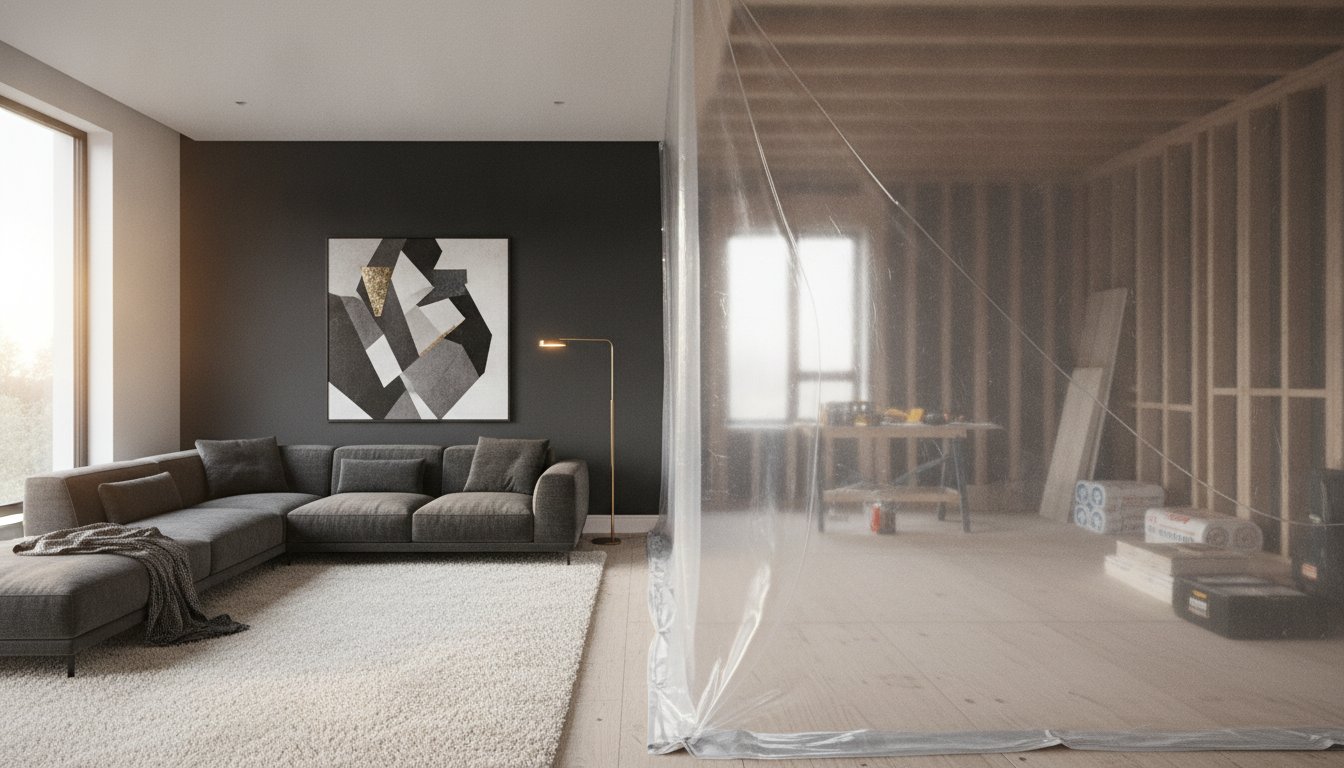
Would you leave a C$15,000 silk rug in the middle of a prairie sandstorm? While a major renovation is an inspiring step toward your dream home, the reality of a construction site often feels like a direct threat to the high-end textiles and sentimental items you’ve spent years collecting. It’s completely natural to feel a sense of trepidation as you consider the impact of fine particulate dust or the movement of heavy machinery near your most valued assets. Protecting your belongings during construction is not a peripheral task; it’s a strategic component of professional project management that preserves the integrity of your lifestyle.
We honour the fact that true peace of mind comes from knowing your investment is in safe, principled hands. This guide shares professional strategies to safeguard your high-value belongings and maintain order during a significant residential transformation. You’ll discover how to create a rigorous protection plan, clarify the complexities of insurance coverage in the Canadian market, and ensure your builder maintains the uncompromising site standards your home deserves.
Key Takeaways
- Learn how to combat microscopic dust, the most persistent threat to high-end interiors, by implementing a comprehensive asset preservation strategy.
- Compare the benefits of on-site “Safe Zones” against the necessity of climate-controlled professional storage for your most sensitive materials.
- Master the professional standards of protecting your belongings during construction, including the strategic use of vapour barriers and a clear understanding of Builder’s Risk insurance limits.
- Adopt a digital inventory system paired with a “Last In, First Out” packing strategy to maintain total control over your high-value items.
- Discover how an integrated project management approach ensures site cleanliness and asset safety are prioritized from the initial design phase through to completion.
The Critical Importance of Asset Protection in Residential Construction
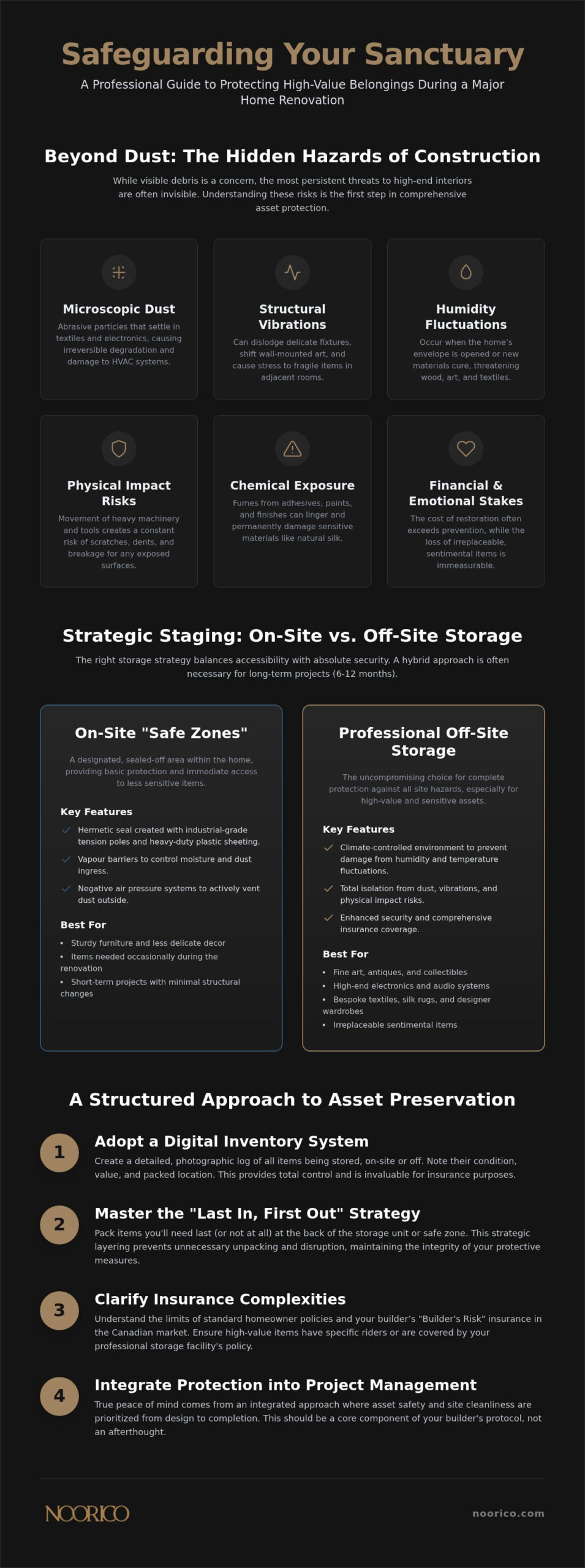
Asset protection in a residential context is a comprehensive strategy designed to mitigate both physical and environmental risks. It transcends the basic concept of site cleanliness; it is a rigorous protocol that ensures the longevity of your interior investments. Protecting your belongings during construction requires a deep understanding of how a site functions and how various materials interact with their surroundings. While many homeowners focus on the visible aspects of a build, the invisible threats often cause the most lasting harm. Microscopic dust, for instance, is the most persistent adversary to high-end interiors. These tiny particles are often abrasive; they settle into the fibres of bespoke textiles or the delicate mechanisms of electronics, causing irreversible degradation.
A well-organized site provides a profound psychological benefit to the homeowner. When you see a project managed with precision, it reinforces your confidence in the builder’s site management and their respect for your property. This order is a direct reflection of Construction site safety protocols, which prioritize the security of both the structure and the treasures within it. By establishing clear boundaries and protection zones, professional teams demonstrate an uncompromising dedication to the final result.
Beyond Dust: Understanding the Hazards of a Major Build
Structural vibrations during a major home addition can resonate through the framing, potentially affecting neighbouring rooms. This movement often leads to delicate fixtures or wall-mounted art shifting or falling if they aren’t properly secured or removed. Homeowners must also account for the following hazards during a transformation:
- Humidity fluctuations: These occur when the home’s envelope is opened or when new materials, such as concrete and plaster, begin curing and releasing moisture into the air.
- Physical impact risks: The movement of heavy machinery and tools in active zones creates a constant risk for any exposed surfaces.
- Chemical exposure: Fumes from adhesives or finishes can linger and affect sensitive materials like natural silk or fine parchment.
Micro-dust acts as a pervasive threat to HVAC systems, often bypassing standard filters and settling deep within the ductwork.
The Financial and Emotional Stakes of High-Value Preservation
The cost of restoring bespoke millwork or high-end finishes often far exceeds the initial investment in preventative measures. A proactive approach to protecting your belongings during construction prevents project delays caused by complex damage claims or the need for specialized restoration services. In the Canadian market, where high-quality materials can be subject to supply chain delays, the loss of a specific asset can stall the completion of an entire room.
Beyond the financial implications, there’s the critical task of protecting the “soul” of the home. Sentimental items and rare collectibles are often irreplaceable; their loss carries an emotional weight that no insurance payout can fully rectify. By integrating protection into the project management phase, we ensure that the transformation of your space doesn’t come at the expense of your most cherished possessions. This visionary approach allows you to focus on the excitement of your new architectural design while remaining certain that your current assets are held in the highest regard.
Strategic Staging: On-Site Protection vs. Professional Off-Site Storage
Deciding where to house your assets during a major renovation requires a balance of accessibility and absolute security. While the desire to keep items within reach is understandable, the reality of a 6 to 12 month build often necessitates a hybrid approach. Protecting your belongings during construction involves categorizing items based on their vulnerability to environmental shifts and physical interference. A visionary partner looks beyond the immediate mess to anticipate how long-term exposure might affect the finish of a bespoke table or the internal components of a high-end audio system.
Creating Safe Zones Within the Construction Site
For items remaining on-site, a “Safe Zone” must be established using industrial-grade tension poles and heavy-duty plastic sheeting to create a hermetic seal. This isn’t a mere dust cover; it’s a structural barrier. We recommend the use of professional air scrubbers to actively filter the air in these rooms, ensuring that any stray particles are captured before they settle. The “centre of the room” staging technique is essential here: move all furniture away from perimeter walls to prevent accidental impact damage during electrical or plumbing work. Restricting foot traffic to these zones is paramount to maintaining the integrity of the seal and the cleanliness of the interior.
When to Utilize Climate-Controlled Off-Site Facilities
Many general advice sources suggest using a garage for temporary storage, but this often ignores the harsh Canadian climate. Seasonal temperature swings and humidity fluctuations can wreak havoc on pianos, oil paintings, and fine leather. High-value assets should be moved to climate-controlled, bonded warehouses where the environment is strictly regulated. This removal should be coordinated at least two weeks before the demolition phase begins to clear the path for structural teams. This strategy minimizes the risk of physical impact from heavy machinery and ensures your most precious items remain in a pristine, stable environment.
A clear framework for deciding what stays and what goes will streamline your preparation. Consider these criteria for off-site storage:
- Vulnerability: Any item sensitive to temperature or humidity shifts.
- Rarity: One-of-a-kind art or sentimental heirlooms that are fundamentally irreplaceable.
- Size: Large furniture that restricts movement and increases the risk of accidental collisions.
This proactive separation reduces site congestion and allows your project management team to maintain a more efficient and secure workspace. By making these strategic decisions early, you ensure the preservation of your home’s character while the architectural transformation takes place.
Evaluating Protection Methods: Professional Standards and Insurance Realities
High-standard asset preservation requires a shift from temporary fixes to industrial-grade solutions. While standard poly-sheeting might offer a placebo effect, protecting your belongings during construction at a professional level demands specialized vapour barriers that resist tearing and maintain airtight integrity over several months. These barriers are engineered to withstand the atmospheric pressures of a live site, ensuring that particulate matter remains isolated from your living quarters. This methodical approach to physical containment is the foundation of a secure, organized construction environment.
The technical precision of your builder’s site management should extend to the very surfaces you walk on. Professional teams don’t rely on thin plastic or cardboard; they utilize materials designed for the rigours of heavy foot traffic and equipment movement. Every protection measure taken must be supported by documented proof, including high-resolution photography of the site before and after the installation of barriers. This creates a transparent record that protects both the homeowner and the builder in the event of a dispute.
Industrial-Grade Dust Barriers and Floor Protection
Maintaining the pristine condition of hardwood or natural stone requires more than a simple drop cloth. Ram Board is the industry standard for floor protection because it’s breathable, allowing new finishes to cure while providing a heavy-duty shield against impacts and spills. To prevent cross-contamination, we utilize zip-wall systems to create airtight seals between active work zones and preserved spaces. A critical but often overlooked step is the sealing of HVAC registers; without this, micro-dust will travel through your ventilation system and settle in rooms far removed from the construction area.
Navigating Builder’s Risk and Homeowner Insurance Policies
There’s often a significant gap in understanding where one insurance policy ends and another begins. A standard “Builder’s Risk” policy is designed to cover the structure and materials during the build, but it frequently excludes your personal belongings and high-value furniture. To bridge this gap, homeowners must secure a “Course of Construction” endorsement on their existing homeowners policy. This specific designation acknowledges that the home is a live site and extends coverage to your assets during the transformation.
Liability for theft on an active site is a complex intersection of contractual law and insurance fine print. Professional builders should carry comprehensive liability as a baseline. However, if you choose to leave high-value items on-site, you must verify that your personal policy covers “off-premises” or “in-transit” risks if they are moved. By aligning your insurance coverage with the physical protection measures on-site, you create a dual layer of security that ensures your investment remains protected from every angle.
A Structured Approach to Packing and Inventory Management
A meticulous inventory is the cornerstone of any sophisticated asset preservation strategy. While generic guides suggest simple labels, protecting your belongings during construction requires a digital-first approach that leaves no room for ambiguity. We advocate for a comprehensive digital inventory using high-resolution photography to document the exact state of every item before it is packed. This provides the empirical evidence required by Canadian insurers should a claim arise. Every angle of a bespoke piece should be captured, ensuring that its condition is verifiable from the moment it enters its protective casing until its eventual return to your refined space.
Effective logistics rely on the “Last In, First Out” (LIFO) strategy to maintain your lifestyle during a residential transformation. Items essential for your daily routine should be the last to be packed and the first to be accessible in your temporary living quarters. To maintain order, we utilize a colour-coded system that assigns specific hues to rooms in the new architectural design. This ensures that as items return to the site, they are placed correctly the first time. This methodical precision minimizes unnecessary handling and reduces the risk of accidental damage during the final stages of the build.
Cataloguing Fine Art, Antiques, and Custom Furnishings
Preserving the character of a home often involves managing delicate antiques and rare art that cannot be replaced. We employ a formal “Condition Report” method, which serves as a forensic record of existing wear before any work begins. For high-value items like fragile chandeliers or large-scale oil paintings, specialized crating is non-negotiable. These custom-built enclosures prevent structural stress during transport and storage. Once the build is complete, a “White Glove” return process ensures that items are unboxed and inspected only after the final post-construction cleaning is certified. Our project management team integrates these rigorous inventory standards into every phase of our bespoke residential transformations.
The Logistics of Temporary Relocation and Accessibility
If you choose to remain in your home during a major addition, accessibility becomes a strategic challenge that requires careful planning. We recommend organizing a “Renovation Suitcase” containing several weeks of essentials to avoid the frustration of searching through sealed crates. Temporary living spaces, such as a localized kitchenette or a curated lounge area, must be established far from the primary work zone. It’s vital to ensure clear paths for labour and materials while protecting stored items from the daily grit of the site. This disciplined approach to space management allows the construction to proceed at pace without compromising your comfort or the safety of your assets.
Integrating Protection into Professional Project Management
Professional project management is the invisible thread that binds architectural vision to physical execution. At NOORICO, protecting your belongings during construction begins long before the first partition is removed. We incorporate site safety and asset preservation into the initial architectural design phase, identifying “Safe Zones” and logistical pathways on the blueprints themselves. This foresight ensures that the movement of materials never compromises the integrity of your existing interior. A visionary builder treats your assets with the same respect as the new build, recognizing that the soul of your home resides in the details you’ve already curated.
The role of the project manager is pivotal in maintaining these standards throughout the “messy middle” of a build. They are the primary enforcement officers for cleanliness, conducting daily inspections to ensure that vapour barriers remain sealed and floor protection stays intact. This rigorous oversight prevents the gradual accumulation of site debris that often plagues less disciplined projects. By treating the construction site as a controlled environment, we mitigate risks before they manifest as damage.
How NOORICO Prioritizes Site Cleanliness and Asset Safety
Our daily site-cleaning protocols far exceed standard industry norms. We don’t just clear large debris; we utilize high-efficiency particulate air (HEPA) filtration to manage the invisible threats discussed earlier. This commitment reflects the intersection of strategic industry knowledge and creative foresight, allowing us to anticipate environmental shifts that could affect your home. We realize that our reputation is built on the persistent dedication we show to every square foot of your property, preserving the professional bonds we’ve cultivated over 25 years in the Canadian market.
Peace of Mind Through Transparent Communication and Expert Execution
Transparency is the foundation of our trust-based approach. Clients receive weekly project updates that include detailed site status reports and specific audits of all asset protection measures. This multi-disciplinary approach ensures that no detail, from the humidity levels in a storage zone to the seal on a zip-wall, is ever overlooked. We provide the steady, structured management required for complex residential transformations, moving you seamlessly from the chaos of construction back to the sophisticated elegance of your finished home.
The “Final Clean” phase is our critical transition back to luxury living. This isn’t a standard dusting; it’s a deep-cleaning protocol that certifies the home is free of micro-particulates before your belongings are unboxed. Discover how we manage Home Additions GTA with uncompromising dedication, ensuring that your expanded lifestyle is grounded in safety and superior design. Protecting your belongings during construction is our promise of reliability, delivered through decades of craft mastery.
Securing the Legacy of Your Refined Space
A residential transformation should be a journey of inspiration rather than anxiety. By implementing a structured digital inventory and choosing the correct balance between on-site safe zones and climate-controlled storage, you ensure that your most cherished items remain pristine. Protecting your belongings during construction is a strategic necessity that requires both creative foresight and technical precision. This methodical approach allows you to focus on the architectural evolution of your home while maintaining absolute confidence in the safety of your current investments.
With over 25 years of sophisticated expert leadership, NOORICO provides an integrated design-build model that prioritizes site cleanliness and asset security. Our uncompromising commitment to superior creative achievements ensures that every detail of your project is handled with the highest level of care and accountability. We invite you to contact NOORICO to discuss your visionary residential project and discover how our principled project management protects your lifestyle. Your dream home deserves a partner who values your past as much as your future.
Frequently Asked Questions
Do I really need to move everything out for a major renovation?
You don’t necessarily need to vacate the entire premises, but protecting your belongings during construction often requires moving sensitive items to off-site storage. While large furniture can sometimes remain in designated safe zones, any items vulnerable to humidity or fine dust should be relocated. A professional project manager will help you determine which pieces are at risk based on the specific architectural changes planned for your home.
How do I protect my hardwood floors from heavy construction traffic?
Utilizing industrial-grade floor protection like Ram Board is the industry standard for safeguarding hardwood and natural stone. Unlike thin plastic, which can trap moisture and damage finishes, Ram Board is breathable and provides a heavy-duty shield against dropped tools and heavy foot traffic. Ensuring all seams are taped with high-quality builder’s tape prevents grit from sliding underneath and scratching the surface during the build process.
Does my standard homeowners insurance cover my belongings during a build?
Standard Canadian homeowners policies often have limitations or exclusions during major renovations. You must contact your provider to secure a “Course of Construction” endorsement to ensure your assets remain covered while the home is a live site. Without this specific designation, your insurer may deny claims related to theft or accidental damage occurring during the construction period. Always verify the limits of your builder’s liability insurance as well.
What is the best way to prevent construction dust from spreading?
Creating airtight seals with zip-wall systems and utilizing HEPA air scrubbers is the most effective way to contain particulate matter. These professional-grade tools capture microscopic dust before it travels into non-work areas. It’s also vital to seal all HVAC registers to prevent contamination from entering your ventilation system. Protecting your belongings during construction requires this multi-layered approach to ensure your living spaces remain breathable and clean.
How can I ensure my fine art and antiques are safe from vibrations?
Removing fine art and antiques from the premises is the only way to guarantee their safety from structural vibrations. If relocation isn’t possible, items should be moved to a central safe zone and housed in specialized crating that absorbs movement. Vibrations from demolition or heavy machinery can cause wall-mounted items to shift or fall, so clearing all shared walls in neighbouring rooms is a mandatory precaution.
When should I hire professional packers for a construction project?
Hiring professional packers is recommended when dealing with high-value collections, bespoke furniture, or complex lighting fixtures like chandeliers. These experts use specialized materials and “White Glove” techniques that go beyond standard household packing. If your renovation involves moving irreplaceable heirlooms or delicate textiles, professional packing ensures these assets are crated and transported with the precision required to prevent environmental or physical degradation.
What happens if my belongings are damaged by a subcontractor?
Your primary builder or project manager is responsible for the conduct and quality of all subcontractors on-site. If damage occurs, it should be covered under the builder’s comprehensive liability insurance. This is why maintaining a documented inventory with high-resolution photography is essential; it provides the empirical evidence needed to process a claim. A reputable builder will have clear protocols for resolving such incidents swiftly and ethically.
How do I manage a digital inventory of my home’s contents?
Managing a digital inventory involves capturing high-resolution photographs of every item from multiple angles before construction begins. You should store these images in a secure cloud-based folder, accompanied by detailed descriptions of the item’s condition and original value. This digital record serves as a forensic “Condition Report” that simplifies the insurance process and ensures every asset is accounted for when it returns to your refined space.