

A construction bid is far more than a simple price tag; it’s a strategic blueprint that aligns your architectural vision with uncompromising financial accountability. With the national residential building construction price index rising 0.6% in the first quarter of 2026, precision in project management has never been more vital for a successful outcome. If you’re currently understanding construction bids and estimates for a custom build or major renovation, you’ve likely realized that the lack of standardized formatting can make objective comparisons feel nearly impossible.
It’s natural to feel a sense of trepidation regarding potential budget overruns or the vague nature of contingency funds. You deserve a partnership rooted in transparency and ethical precision rather than one clouded by hidden costs. This guide will empower you to master the complexities of residential project costing, ensuring your investment is protected by a clear, principled contract. We will examine the critical distinctions between preliminary estimates and final bids, decode the true purpose of a project contingency, and provide the tools you need to sign your construction agreement with absolute confidence.
Key Takeaways
- Distinguish between preliminary assessments and formal offers to ensure your custom build rests on a foundation of financial clarity.
- Master the art of understanding construction bids and estimates by identifying the essential direct and indirect costs that drive high-end project budgets.
- Compare fixed-price and cost-plus contract models to determine which structure offers the best transparency and protection for your specific investment.
- Identify subtle red flags in builder quotes, from missing insurance to vague line items, to ensure you are comparing competing bids objectively.
- Learn how a multidisciplinary approach to architectural design and project management bridges the gap between sophisticated vision and project execution.
The Foundation of Project Costing: Estimates vs. Bids
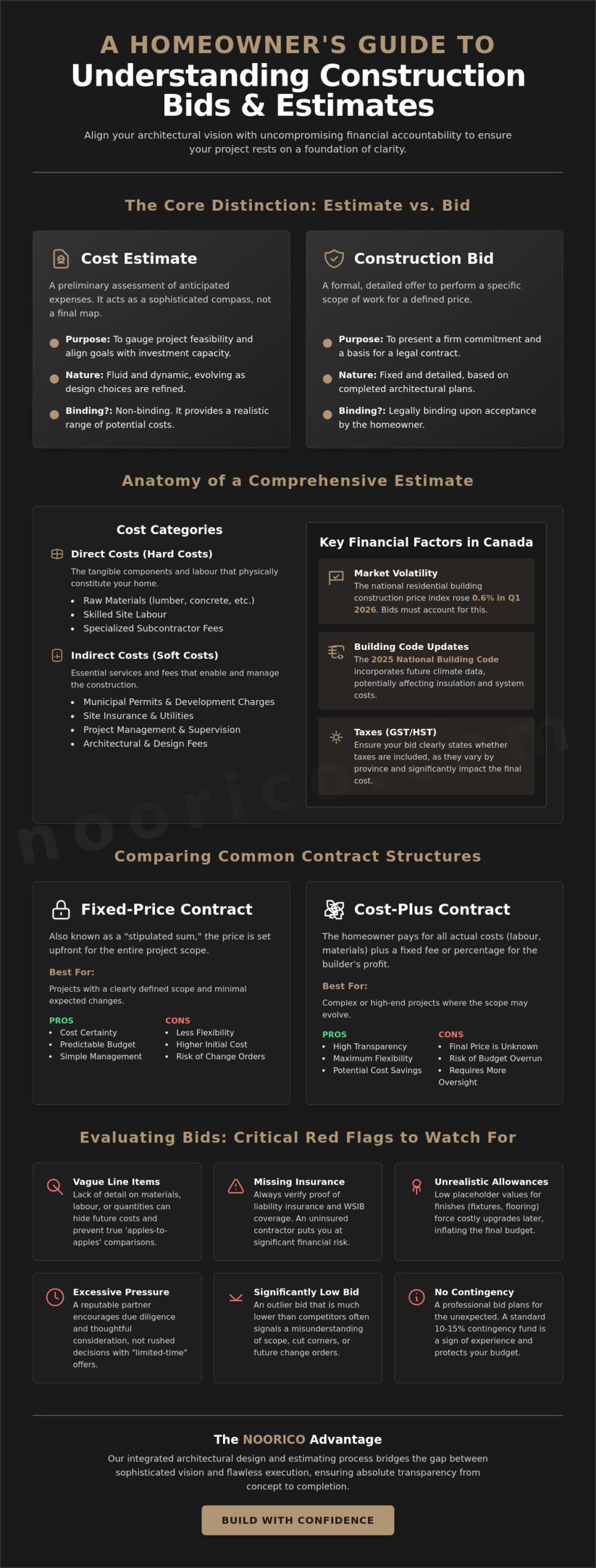
Establishing the financial architecture of a custom home begins with distinguishing between two critical documents. A cost estimate is a preliminary assessment of anticipated expenses; it serves as a sophisticated compass rather than a final map. It provides a range of potential costs based on initial architectural design and historical data. Conversely, a construction bid is a formal offer to perform a specific scope of work at a defined price. It’s the moment where abstract numbers transform into a binding commitment.
The distinction between these two is central to understanding construction bids and estimates. While an estimate is fluid and evolves as your vision takes shape, a bid is typically binding. This transition occurs during the pre-construction phase, a period of persistent dedication where builders and homeowners refine every detail. This phase eliminates ambiguity, ensuring that when you sign a contract, the financial expectations are grounded in reality rather than optimistic guesses.
The Evolution of a Residential Estimate
A project’s financial narrative begins with conceptual estimates. These early figures help determine feasibility during the initial architectural design phase, allowing you to align your creative goals with your investment capacity. As the project matures, we develop detailed estimates that break down labour, high-quality materials, and specialized trade requirements. Every design choice you make directly influences the precision of the final bid. Selecting a rare marble or a complex structural system will shift the estimate, demanding a more granular analysis before the final offer is presented.
Why Accuracy Matters for Custom Builds
In the world of high-end residential construction, the danger of “low-balling” is a significant risk. Some providers may present artificially low figures to win a contract, only to introduce change orders later that compromise the project’s integrity. Accurate bidding protects your home’s long-term resale value by ensuring that the quality of execution remains uncompromising from start to finish. Professional project management plays a pivotal role here. By maintaining budget integrity through every phase, we provide the quiet confidence that your significant investment is in safe, principled hands.
Anatomy of a Comprehensive Construction Estimate
A comprehensive estimate serves as the financial heartbeat of your project. It transforms the aspirational sketches of architectural design into a tangible fiscal reality. For a homeowner, understanding construction bids and estimates requires a deep dive into the granular details that constitute a high-end build. These documents aren’t merely lists of prices; they are sophisticated risk-management tools that account for the practical grit of the job site and the elegance of superior design. The Government of Canada’s Guide to Assessing Cost Estimates provides a reliable framework for classifying these expenses, ensuring every dollar is attributed with ethical precision.
Direct costs represent the physical manifestation of your home. They include the raw materials, the skilled site labour, and the specialized subcontractor fees required to execute complex structural or aesthetic features. Indirect costs are equally vital but less visible. These encompass municipal permits, site insurance, and the persistent dedication of site supervision. In Canada, we must also account for the 2025 National Building Code updates. These regulations now integrate future climate data, which often necessitates more robust insulation or advanced greenhouse gas mitigation systems, directly impacting your initial figures.
Hard Costs vs. Soft Costs in Canada
Hard costs are the tangible components of your build, from the concrete foundation to the slate roof. Soft costs, however, involve the professional expertise that guides the project, such as interior design fees and project management services. When reviewing your budget, remember that the national residential building construction price index rose by 0.6% in the first quarter of 2026. This volatility makes it essential to account for GST or HST, which varies by province, as these taxes significantly alter your final bottom line. Municipal development charges can also fluctuate, making early verification a pillar of financial stability.
Allowances and Selection Schedules
Allowances offer a structured way to maintain flexibility for interior design choices without delaying the initial bid. They act as placeholders for items like bespoke fixtures or premium flooring. While they provide breathing room, under-budgeting for these finishes is a common pitfall in luxury renovations. Detailed specifications are your best defence against hidden costs. By defining every appliance and hardware finish early, you move from a fluid estimate to a precise bid. This methodical approach ensures that your vision for a sophisticated home is never compromised by unforeseen financial gaps.
Comparing Construction Contracts: Fixed-Price vs. Cost-Plus
The contractual agreement is the legal architecture that protects your investment. It translates a builder’s bid into a binding promise of performance. When you’re understanding construction bids and estimates, the contract type you select acts as the final arbiter of financial risk. In Canada, the Canadian Construction Documents Committee (CCDC) provides standardized forms that offer a balanced framework for both parties. These documents ensure that your project is grounded in industry best practices and ethical accountability. Choosing between a fixed-price and a cost-plus model depends entirely on your project’s complexity and your personal comfort with financial fluidity.
A hybrid solution often utilized in high-end builds is the Guaranteed Maximum Price (GMP). This structure provides the transparency of a cost-plus model while establishing a fiscal ceiling to protect the homeowner. If the final costs are lower than the estimate, the savings are often shared; if they exceed the limit, the builder absorbs the difference. This aligns the builder’s efficiency with your financial protection, creating a partnership rooted in mutual success. Regardless of the model, ensure your contract clearly states whether GST or HST is included in the total, as these taxes can significantly alter your final capital requirement.
The Fixed-Price Model: Certainty and Scope
The Fixed-Price model, or Stipulated Sum (CCDC 2), offers the quiet confidence of a set price. It is the ideal choice for home additions or custom builds with a rigidly defined scope. This model shifts the risk of rising material costs to the builder, providing you with a clear financial horizon before you break ground. However, this certainty requires a trade-off. Your architectural design and interior design plans must be 100% complete before signing. Any evolution in your vision during construction will require a formal ‘Change Order’. These adjustments can lead to budget expansions if the initial planning was not sufficiently rigorous.
Cost-Plus Contracts: Flexibility for Bespoke Projects
For complex major renovations where the full scope remains evolving, the Cost-Plus model (CCDC 3) offers unparalleled flexibility. You pay the actual cost of labour and materials plus a pre-negotiated management fee. This ‘open-book’ approach ensures total transparency, as you see every subcontractor invoice and material receipt. It’s a sophisticated expert’s choice for luxury projects where superior creative achievements are prioritized over a rigid price tag. Success here relies on persistent dedication to project management. Detailed monthly reporting and rigorous auditing are essential to maintain accountability and ensure your capital is deployed with maximum efficiency.
Evaluating Bids: Beyond the Bottom Line
The final selection of a builder is a decision that defines the next several years of your life. While the bottom-line figure is often the first point of focus, true mastery in understanding construction bids and estimates involves looking past the numerical total to the substance of the proposal. An “apples-to-apples” comparison is only possible when every bidder adheres to the exact same architectural specifications. If one quote appears significantly lower, it often indicates a failure to account for the persistent dedication required for high-end finishes or complex structural requirements. The cheapest bid frequently transforms into the most expensive project through unforeseen change orders and liability gaps that emerge once ground is broken.
Red flags are often hidden in what is missing rather than what is present. Vague line items like “flooring” without a specific material grade or “site prep” without a detailed breakdown suggest a lack of site-specific foresight. You must also verify that the builder carries comprehensive insurance and is deeply rooted in their specific geographic region. A builder’s track record and their commitment to ethical pillars are the strongest indicators of project success. Choosing a partner based on professional reliability ensures that your significant investment remains in safe, principled hands throughout the transformation of your home.
Reviewing the Scope of Work
A meticulous review ensures that every nuance of the architectural design is captured within the quote. You must verify what the builder is NOT responsible for; exclusions like landscaping, utility hookups, or specialized permits can create significant financial surprises. A professional bid will include a clear timeline and a project milestone schedule. These milestones create a predictable and reassuring flow, allowing you to track progress against your financial commitments with absolute clarity. If a bidder cannot provide a structured schedule, it’s a sign that their operational process may lack the necessary organizational order.
Assessing the Management Fee
Project management fees are often misunderstood as mere overhead. In reality, they represent the cost of superior creative achievements and the quiet confidence that comes from expert oversight. This fee covers the rigorous coordination of skilled trades and the persistent safeguarding of your investment. When evaluating this fee, consider the builder’s communication style and professional reliability. A visionary partner doesn’t just manage a site; they act as a multi-disciplinary guide through the complex intersections of finance and execution. This level of service ensures that the final product meets the high standard of distinction you expect for your custom home.
Ready to align your vision with a transparent financial blueprint? Connect with our team to discuss how our integrated approach ensures your project is built on a foundation of accountability.
The NOORICO Advantage: Integrated Design and Estimating
Traditional construction often suffers from a disconnect between the visionary architect and the practical builder. By bringing architectural design and project management under one professional roof, we dissolve this barrier. This integrated approach is essential for understanding construction bids and estimates because it ensures that the creative vision is calibrated against real-world costs from the very first sketch. We don’t just build homes; we curate an experience where ethical transparency and decades of industry experience serve as the foundation for your significant investment. Our team projects an image of deep-seated reliability, ensuring your vision isn’t lost in translation between separate entities. We believe that financial transparency is an ethical pillar, not just a business requirement.
This multidisciplinary synergy allows us to address the “gap” that often exists between a designer’s dream and a builder’s reality. When these two worlds are siloed, homeowners frequently face the heartbreak of receiving bids that far exceed their initial expectations. By integrating these services, we provide a seamless transition from abstract values to concrete execution. This process is highly logical and structured, mirroring the operational excellence we bring to every job site. It’s a trust-based approach that replaces high-pressure sales with quiet confidence and accountability.
Streamlining the Pre-Construction Phase
Our multidisciplinary team utilizes strategic industry knowledge to provide accurate early-stage estimates. We realize bespoke living spaces by aligning sophisticated aesthetics with a disciplined financial order. This synergy eliminates the friction often found when a third-party builder receives plans that are financially unfeasible. You gain the peace of mind that comes from a single point of accountability. Every detail, from the structural integrity to the interior design finishes, is accounted for within a cohesive narrative that respects your capital. This methodical approach mirrors our operational process: organized, step-by-step, and transparent. It’s how we move from inspiration to practical implementation without the uncertainty of budget overruns.
Building Your Legacy with Confidence
A custom build or major home addition is an enduring professional bond between the visionary partner and the homeowner. Our persistent dedication to superior creative outcomes means we manage the complex intersections of design, finance, and execution with quiet confidence. We understand that your home is your legacy. By mastering the nuances of understanding construction bids and estimates through an integrated lens, we protect your investment while delivering a product of unmatched distinction. We remain deeply rooted in our region, offering a local expertise that grounds high-level aspirations in tangible reality. Discover how NOORICO can elevate your next project.
Building Your Future on a Foundation of Transparency
Mastering the nuances of understanding construction bids and estimates is the first step toward a successful and rewarding custom build. By distinguishing between preliminary assessments and binding offers, you protect your capital and ensure your vision remains uncompromised. This guide has highlighted the importance of detailed scope reviews and the strategic selection of contract models to align with your personal risk tolerance. You now possess the tools to evaluate builders objectively, focusing on ethical pillars and professional reliability rather than just the lowest price.
NOORICO brings over 25 years of established expertise to every project, specializing in high-value residential transformations that demand a sophisticated touch. Our integrated approach to architectural and interior design eliminates the traditional friction between budget and beauty, providing you with a single point of accountability from inspiration to execution. We invite you to experience the quiet confidence that comes from a partnership rooted in persistent dedication and superior creative achievements. Partner with NOORICO for Your Custom Home Journey and begin the process of realizing a home that stands as a testament to quality and enduring professional bonds.
Frequently Asked Questions
What is the difference between a quote and a construction bid?
A construction bid is a formal, binding commitment to perform a specific scope of work for a set price, whereas a quote is often a more informal price indication. Bids are typically based on completed architectural design documents and represent a professional offer that forms the basis of your contract. Quotes may lack the granular detail required for a custom home build and often serve as a preliminary assessment during the early stages of project planning.
How long does it take to receive a detailed estimate for a custom home?
Receiving a detailed estimate for a custom home typically requires several weeks of persistent dedication during the pre-construction phase. This timeframe allows your visionary partner to coordinate with specialized trades and source accurate material pricing. Rushing this process often leads to inaccuracies; a methodical approach ensures the final figures reflect the true complexity of your architectural vision and financial requirements.
Why do construction bids vary so much between different builders?
Bids vary because builders interpret the scope of work differently or utilize varying qualities of materials and site supervision. One builder might include premium finishes and comprehensive project management, while another might exclude essential soft costs like permits or insurance. Understanding construction bids and estimates requires you to look beyond the bottom line to ensure every quote accounts for the same level of distinction and precision.
What is a ‘Change Order’ and how does it affect my final price?
A Change Order is a formal document that modifies the original contract scope, price, or timeline after construction has commenced. It’s used when your vision evolves or when unforeseen site conditions require a shift in execution. While common in major renovations, frequent change orders can lead to significant budget expansions. Professional project management aims to minimize these by ensuring the initial bid is as comprehensive as possible.
Should I always choose the builder with the lowest bid?
Selecting the lowest bid is often a high-risk strategy that can lead to compromised quality or hidden costs later in the project. An unrealistically low price may indicate that a builder has missed key architectural design requirements or lacks the necessary insurance and skilled labour. You should prioritize a builder’s track record and ethical pillars over a cheap price tag to ensure your investment is in safe, principled hands.
Does a construction estimate include the cost of building permits in Canada?
Whether an estimate includes permit costs depends entirely on the builder’s specific proposal and the contract model selected. Some firms include municipal permit fees as part of their comprehensive project management, while others categorize them as soft costs to be paid directly by the homeowner. Always verify these exclusions during the process of understanding construction bids and estimates to avoid unexpected financial gaps during the development phase.
How much should I set aside for a contingency fund in a major renovation?
Industry professionals typically recommend setting aside a contingency fund of 10% to 20% of the total project budget for major renovations. This fund acts as a strategic tool for risk mitigation, covering unforeseen structural issues or evolving design choices. Having this buffer provides the quiet confidence needed to manage the practical grit of a job site without compromising your long-term financial stability.
What are CCDC contracts and why are they important for Canadian homeowners?
CCDC contracts are standardized agreements developed by the Canadian Construction Documents Committee to provide a balanced and fair framework for all parties. These documents are vital for Canadian homeowners because they establish clear rules for payment, dispute resolution, and project milestones. Utilizing a CCDC contract ensures your project is grounded in industry best practices and protects the enduring professional bonds between you and your builder.