
In 2026, the true cost to build a house in Ontario is no longer measured simply by the price of raw materials, but by the strategic foresight required to protect your investment from a shifting regulatory environment. You likely realize that building a custom home is an act of persistent dedication to quality, yet the lack of transparency in standard contractor quotes often creates unnecessary friction. It’s natural to feel concerned about hidden fees or the potential for architectural compromise when the financial landscape feels so volatile.
This guide promises to replace that uncertainty with a sophisticated roadmap of the current financial landscape, from initial architectural design to the final interior finishes. We will explore how the 2026 Ontario Building Code updates and the temporary HST rebate for eligible homes impact your bottom line. By analyzing regional cost variations and the stabilized 2.25 percent Bank of Canada policy rate, we provide the clarity you need to select a design-build partner who honours your vision and your legacy.
Key Takeaways
- Master the nuances of the 2026 Ontario Building Code to ensure your project remains compliant while maximizing energy efficiency and long-term value.
- Gain a transparent breakdown of the cost to build a house in Ontario by separating physical construction expenses from often-overlooked soft costs.
- Evaluate how bespoke architectural features and high-end interior design choices serve as the most significant variables in your custom home investment.
- Protect your capital by identifying silent budget-eaters and implementing a rigorous project management strategy to eliminate mid-construction change orders.
- Recognize the strategic benefit of an integrated design-build model that aligns creative foresight with practical execution to streamline your path to completion.
The Economic Landscape of Building in Ontario in 2026
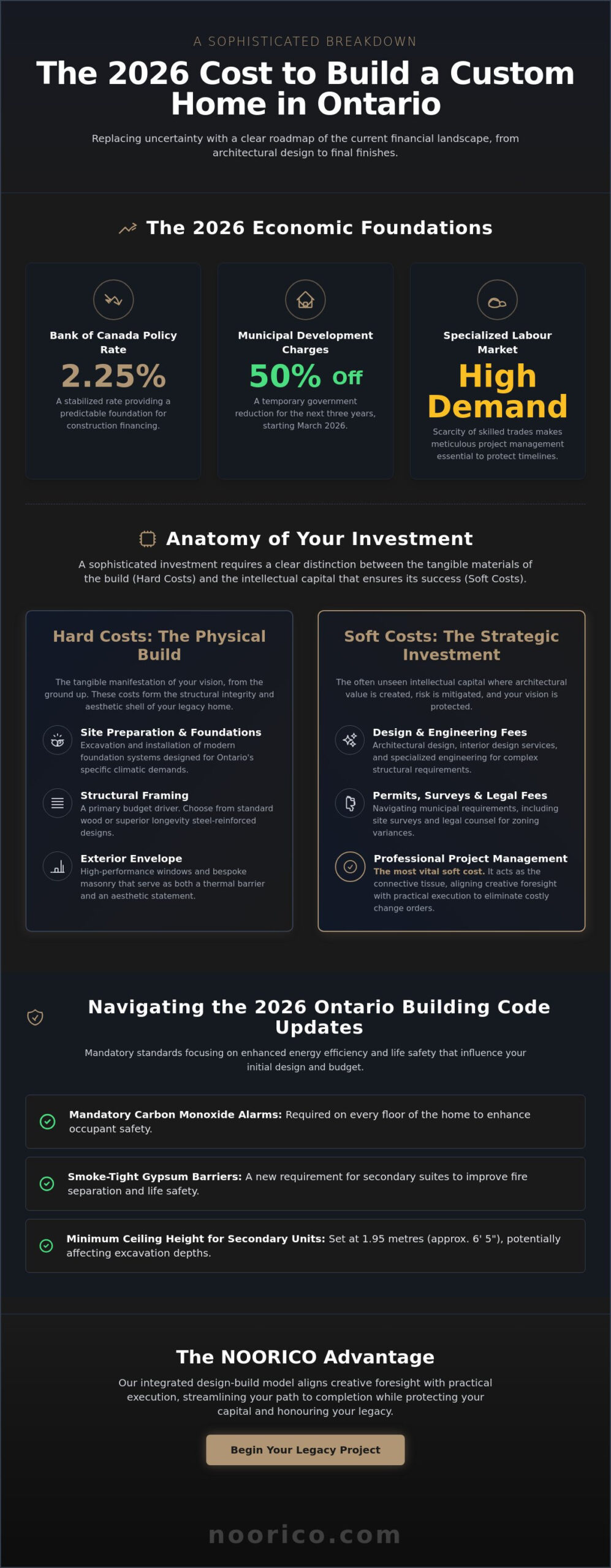
Understanding the total cost to build a house in Ontario requires a perspective that values precision over approximation. In 2026, the market has shifted from the frantic volatility of the early decade to a state of disciplined stabilization. The Bank of Canada policy rate currently sits at 2.25 percent, which provides a predictable foundation for those securing construction financing. For the sophisticated homeowner, this environment demands a transition from traditional price-per-foot estimates to a value-per-outcome philosophy. This approach ensures the investment is measured by the enduring quality of the final design rather than just the volume of materials used.
Inflationary Pressures and Material Volatility
While global supply chains have found a new equilibrium, the scarcity of specialized labour in Ontario remains a defining factor. Skilled trades are in high demand, which means that meticulous project management is the only way to safeguard your timeline. Lumber and steel availability has improved, yet high-end finishes still require early procurement to secure current pricing. By engaging with the residential construction process through early architectural design, you can lock in commitments from suppliers. This persistent dedication to early planning acts as a vital buffer against any localized price fluctuations. Starting the design process early isn’t just about aesthetics; it’s a strategic financial manoeuvre that protects your capital from future inflationary spikes.
Regulatory Shifts in the 2026 Building Code
The 2026 updates to the Ontario Building Code introduce mandatory standards that directly influence your initial budget. These changes focus on energy efficiency and life safety, including mandatory carbon monoxide alarms on every floor and smoke-tight gypsum barriers for secondary suites. The code also specifies a minimum ceiling height of 1.95 metres for legal secondary units, which may affect excavation depths for new builds. While these requirements add layers to the design phase, they are balanced by a significant policy shift. In March 2026, the government announced a 50 percent reduction in municipal development charges for the next three years. Navigating these regulatory intersections requires a partner who understands how to leverage these incentives to manage the overall cost to build a house in Ontario. This specialized knowledge ensures that your home meets the highest safety standards without compromising your financial goals.
The Anatomy of an Investment: Hard Costs vs. Soft Costs
Many homeowners fixate on the visible elements of construction, yet the total cost to build a house in Ontario is often determined by the strategic decisions made before the first shovel hits the ground. While “price per square foot” remains a common industry metric, it’s a blunt instrument that fails to account for the nuances of high-end design. A sophisticated investment requires a clear distinction between the tangible materials of the build and the intellectual capital that ensures its success. According to recent Building construction price indexes, the stabilization of residential inputs has made precision in cost categorization more critical than ever for maintaining a predictable budget.
Breaking Down Hard Construction Costs
Hard costs represent the physical manifestation of your vision. This category includes site preparation, excavation, and the installation of modern foundation systems designed for Ontario’s specific climatic demands. The choice of structural framing is a primary budget driver; moving from standard wood to steel-reinforced designs offers superior longevity but requires a higher initial outlay. Similarly, the exterior envelope serves as both a thermal barrier and an aesthetic statement. Investing in high-performance windows and bespoke masonry ensures that the residence performs as well as it looks. These components form the “grit” of the project, providing the structural integrity required to house a lasting legacy.
The Vital Role of Soft Costs in Luxury Builds
Soft costs are where architectural value is actually created, yet they often surprise those who are unprepared. This category encompasses architectural design fees, interior design services, and the specialized engineering required for complex structural feats. You must also account for site surveys and legal fees associated with zoning variances. Professional project management is the most vital soft cost of all. It acts as the connective tissue between industry expertise and execution, ensuring that your significant investment is protected from inefficiency. In the bespoke market, these fees aren’t merely administrative expenses. They’re an investment in property value that distinguishes a generic structure from a curated masterpiece.
A comprehensive contingency fund is your final financial hedge. In the 2026 market, we advise clients to maintain a reserve that reflects the complexity of their site and the ambitious nature of their finishes. This fund isn’t an admission of poor planning; it’s a tool of quiet confidence. It allows you to address unforeseen site conditions or unique opportunities for refinement without compromising the project’s momentum. Balancing these hard and soft expenses with a disciplined approach ensures the cost to build a house in Ontario remains a transparent and rewarding journey from concept to completion.
How Design Complexity and Quality Influence Your Budget
Design complexity serves as the primary driver of variance when calculating the total cost to build a house in Ontario. While basic structures often adhere to a linear pricing model, a bespoke residence involves a sophisticated interplay of creative ambition and technical execution. You shouldn’t view design as a mere aesthetic layer; it’s the fundamental blueprint of your financial commitment. According to Statistics Canada’s 2026 building construction price index, the cost of specialized residential components has outpaced standard material inflation. This reality makes the role of a visionary partner critical for those who wish to balance high-level aspirations with financial discipline.
Architectural Ambition and Structural Engineering
The pursuit of superior creative achievements often necessitates structural feats that transcend standard building practices. Cantilevered sections, massive open-span layouts, and floor-to-ceiling glass walls create a profound sense of elegance, but they also demand rigorous engineering and increased labour intensity. These features don’t just add to the material list. They require a high-intensity, uncompromising commitment to precision during the framing and assembly stages. Complex rooflines and custom elevations further distinguish a property, yet they require an authoritative grasp of structural realities to ensure the home remains as durable as it is beautiful. When you prioritize architectural distinction, you’re investing in the specialized expertise required to make the impossible tangible.
Curating Premium Interior Finishes
Interior design represents the single largest variable in a custom home budget. The transition from commercial-grade fixtures to artisan-crafted elements can shift the financial landscape of a room significantly. For instance, bespoke cabinetry and custom millwork serve as the cornerstone of a luxury investment, providing a level of distinction that off-the-shelf solutions cannot match. Integrating advanced automation systems and smart home technology also adds a layer of modern sophistication, though these require specialized project management to execute flawlessly. Every choice, from the grain of the wood to the precision of the lighting controls, reflects a persistent dedication to a superior living experience.
Ultimately, the value of sustainable building technologies should be measured by their cost-to-value ratio over the home’s lifecycle. While high-performance HVAC systems and superior insulation require a higher initial outlay, they offer a quiet confidence in the home’s longevity and efficiency. Balancing these aesthetic aspirations with the grit of structural engineering is what defines the true cost to build a house in Ontario in 2026. This methodical approach ensures that every dollar spent contributes to a home that reflects your personal legacy and stands as a testament to quality craftsmanship.
Mitigating Risk: Avoiding the Hidden Costs of Construction
Protecting your investment requires more than a signature on a contract. It demands an uncompromising commitment to identifying silent budget-eaters before they surface, ensuring that your financial legacy remains intact. While a fixed-price contract might seem like the safest route, it often lacks the flexibility to address the sophisticated realities of bespoke construction. A rigid agreement can lead to friction when site-specific challenges arise, potentially resulting in the very architectural compromises you wish to avoid. True risk mitigation is found in the intersection of strategic industry knowledge and creative foresight, where every potential obstacle is accounted for within the total cost to build a house in Ontario.
Pre-Construction Due Diligence
Meticulous site surveys and geotechnical reports form the foundation of financial stability. You don’t want to discover poor soil quality or outdated utility hookups after the project begins. In many Ontario regions, heritage or environmental restrictions can impose significant delays if they aren’t identified during the design phase. Even the real cost of demolishing existing structures requires a precise calculation that considers hazardous material abatement and waste diversion. This phase is about the practical grit of project management. By conducting thorough due diligence, you realize a sense of quiet confidence that your capital is protected from the unforeseen.
Strategic Project Oversight
Change orders are the most significant financial danger in residential construction, often stemming from a lack of initial clarity or fragmented communication. Professional Project Management serves as the primary shield against these disruptions. Our integrated approach ensures accountability through every phase of the construction lifecycle, from the first architectural drawing to the final interior finish. This persistent dedication to oversight reduces costly delays and scheduling conflicts that plague less organized projects. We utilize transparent accounting to build a trust-based relationship, providing you with a clear view of how your investment is being utilized to achieve superior creative achievements.
Navigating the complexities of provincial permit approvals and municipal requirements is a multi-disciplinary task. It requires a seasoned professional who has mastered the craft of balancing structural realities with aesthetic aspirations. When you partner with a sophisticated expert, you aren’t just hiring a builder; you’re securing a visionary guide who anticipates risks before they impact your budget. This methodical approach ensures that the cost to build a house in Ontario remains predictable, allowing you to focus on the transformation of your vision into a tangible masterpiece.
The NOORICO Advantage: An Integrated Design-Build Approach
The decision to build a custom home is an investment in a personal legacy, and the structure of your partnership determines the success of that investment. NOORICO provides an integrated design-build model that synchronizes architectural foresight with meticulous project management. By housing architects, interior designers, and builders under one roof, we eliminate the fragmentation that often inflates the cost to build a house in Ontario. This cohesive environment ensures that every creative decision is grounded in financial reality, protecting you from the friction of misaligned expectations. It’s a trust-based approach that prioritizes accountability, ensuring your capital is managed with the same precision applied to our high-end designs.
Bespoke Design Meets Professional Rigour
Our integrated model brings bespoke design and professional rigour into a single, fluid process. We believe that interior styling should be considered from the very first blueprint, rather than as an afterthought. This synchronization allows us to identify structural opportunities for aesthetic distinction early in the design phase. Our “Who-What-Why” progression defines our specific role in your journey. As your visionary partner, NOORICO executes a multi-disciplinary strategy to streamline the transition from concept to completion, allowing you to realize the emotional and financial benefit of a home that exceeds every standard of quality. This method transforms the construction journey from a series of stressful transactions into a predictable and inspiring evolution of your personal vision.
A Legacy of Excellence in Ontario Construction
A legacy of excellence in Ontario construction is built through persistent dedication to the craft and the enduring professional bonds we maintain with our clients. For 25 years, we’ve remained deeply rooted in our region, mastering the complex intersections of industry, finance, and execution. We project an image of reliability and quiet confidence, leaning on ethical pillars to reassure you that your significant investment is in safe, principled hands. This longevity serves as a badge of local expertise that generic contractors simply cannot replicate. When you choose an integrated partner, you’re choosing a team that understands how to navigate the specific cost to build a house in Ontario while maintaining an uncompromising commitment to the final product.
Our reputation is grounded in decades of industry experience and elevated by a pursuit of superior creative achievements. We don’t just provide a service; we act as a multi-disciplinary guide through the complexities of modern residential construction. This methodical approach mirrors the operational process itself: organized, step-by-step, and entirely transparent. By aligning our interests with yours from day one, we create a persuasive narrative arc that moves from initial inspiration to practical implementation. Begin your visionary transformation with NOORICO today and experience the clarity of a truly integrated partnership.
Securing Your Legacy Through Strategic Architectural Excellence
Building a custom home in 2026 requires more than just a budget; it demands a sophisticated understanding of how regulatory shifts and design complexity intersect. You’ve learned that the true cost to build a house in Ontario is managed through early procurement and an uncompromising commitment to pre-construction due diligence. By prioritizing value-per-outcome over misleading square-foot metrics, you ensure your investment yields a residence of enduring distinction. This strategic foresight allows you to navigate the current economic landscape with quiet confidence.
NOORICO brings over 25 years of persistent dedication to architectural excellence to every project we undertake. Our integrated design-build model ensures a seamless project lifecycle, providing a stable foundation for high-end residential transformations and bespoke homes. We bring specialized expertise to every stage of construction, ensuring that your creative achievements are grounded in practical project management. We invite you to partner with NOORICO for your custom home build and experience the reliability of a visionary guide. Together, we can transform your aspirations into a tangible masterpiece that stands as a testament to quality craftsmanship for generations to come.
Frequently Asked Questions
How much does it cost to build a custom home in Ontario per square foot in 2026?
The average cost to build a house in Ontario in 2026 ranges from $340 to $575 per square foot, not including the price of the lot. In premium regions like the Greater Toronto Area and the 905, these figures typically start at $420 and can exceed $575 for bespoke finishes. This investment reflects the persistent dedication required to achieve architectural excellence in a market defined by high-quality standards and specialized labour.
What are the typical soft costs for a residential build in Ontario?
Typical soft costs for an Ontario residential project generally add between $25 and $55 per square foot to the total budget. These expenses encompass architectural design, structural engineering, site surveys, and municipal permit fees. By accounting for these intellectual investments early, you ensure that the creative foresight required for a sophisticated home is fully funded without compromising the physical construction quality or the structural integrity of the build.
How long does it take to get a building permit in Ontario right now?
Building permit timelines in Ontario vary by municipality, though the digitalization of documentation for inspections and approvals is becoming a standard that can expedite the process. While simple residential permits might be processed in a few weeks, complex custom builds often require several months for a full review and approval. Engaging a partner with local expertise ensures that your application is meticulously prepared to meet provincial standards and minimize administrative delays.
Is it cheaper to renovate an existing home or build a new one from scratch?
Determining whether to renovate or build from scratch depends on the structural integrity of the existing residence and your long-term goals. While major renovations can preserve a property’s character, building a new custom home offers the freedom to implement a completely bespoke architectural vision. Both paths require professional project management to navigate the specific cost to build a house in Ontario while ensuring the final result reflects your personal legacy.
What is the difference between a design-build firm and a general contractor?
A design-build firm integrates architectural design and construction under one roof, whereas a general contractor primarily executes plans provided by an external architect. This integrated model streamlines the transition from concept to completion, reducing the risk of misaligned expectations or communication gaps. By synchronizing creative foresight with practical grit, design-build firms provide a more predictable and reassuring path for homeowners making a significant investment in a high-end property.
How much should I set aside for a contingency fund during construction?
We recommend setting aside a contingency fund of at least 10 to 15 percent of the total project value to address unforeseen site conditions or refinements. In a market where material price fluctuations can still occur, this reserve acts as a tool of quiet confidence. It ensures that your project maintains its momentum and quality standards even when navigating the inherent complexities of modern residential construction and bespoke interior finishes.
Does the Ontario Building Code 2026 increase construction costs significantly?
The 2026 Ontario Building Code updates introduce stricter energy efficiency and safety standards that influence initial construction outlays. Requirements such as mandatory carbon monoxide alarms on every floor and smoke-tight barriers for secondary suites add layers of complexity to the design phase. However, these costs are often balanced by long-term energy savings and the significant 50 percent reduction in municipal development charges announced by the government in March 2026.
How do I choose the right custom home builder for a high-end project?
Choosing the right builder for a high-end project involves evaluating their longevity, ethical pillars, and commitment to transparency. Look for a visionary partner who demonstrates a persistent dedication to quality and remains deeply rooted in your specific geographic region. A sophisticated expert will prioritize open communication and accountability, ensuring that your significant investment is protected by a seasoned professional who has mastered their craft over many years.