
The perceived security of a fixed price agreement often acts as a veil that masks future compromises to your architectural vision. While many homeowners reach for the certainty of a set number, the most distinguished projects in the Toronto GTA rely on a more nuanced alignment of risk and reward. You’ve worked hard to secure your investment, and it’s natural to feel uneasy when residential construction costs have risen by 2.8 percent year-over-year as of early 2026. You deserve a partnership built on integrity rather than hidden margins or sudden budget overruns.
This guide provides the clarity you need to decide between a fixed price vs cost plus construction contract canada by focusing on your specific project goals. Our approach is professional, and our methodology is transparent. We’ll explore how the 2025 CCDC contract updates and the January 1, 2026, Ontario Construction Act amendments affect your financial protections and accountability. You’ll gain a strategic framework to select a model that ensures your builder’s commitment to excellence remains relentless. We’ll begin by breaking down how each contract type manages transparency and protects your capital in an evolving market.
Key Takeaways
- Understand how the latest CCDC standards and Ontario’s updated Construction Act provide a foundation of fairness and transparency for your premium project.
- Realize why the Fixed Price model offers the budget certainty required by lenders while demanding a meticulously defined scope of work to prevent hidden costs.
- Evaluate the fixed price vs cost plus construction contract canada framework to determine which model best aligns with your architectural vision and tolerance for market volatility.
- Identify the five strategic pillars—including transparency and speed—that determine which agreement protects your investment while fostering a relationship built on integrity.
- Discover how an integrated design-build approach ensures your project is managed with relentless excellence, regardless of the underlying financial model.
Understanding the Canadian Landscape of Construction Contracts
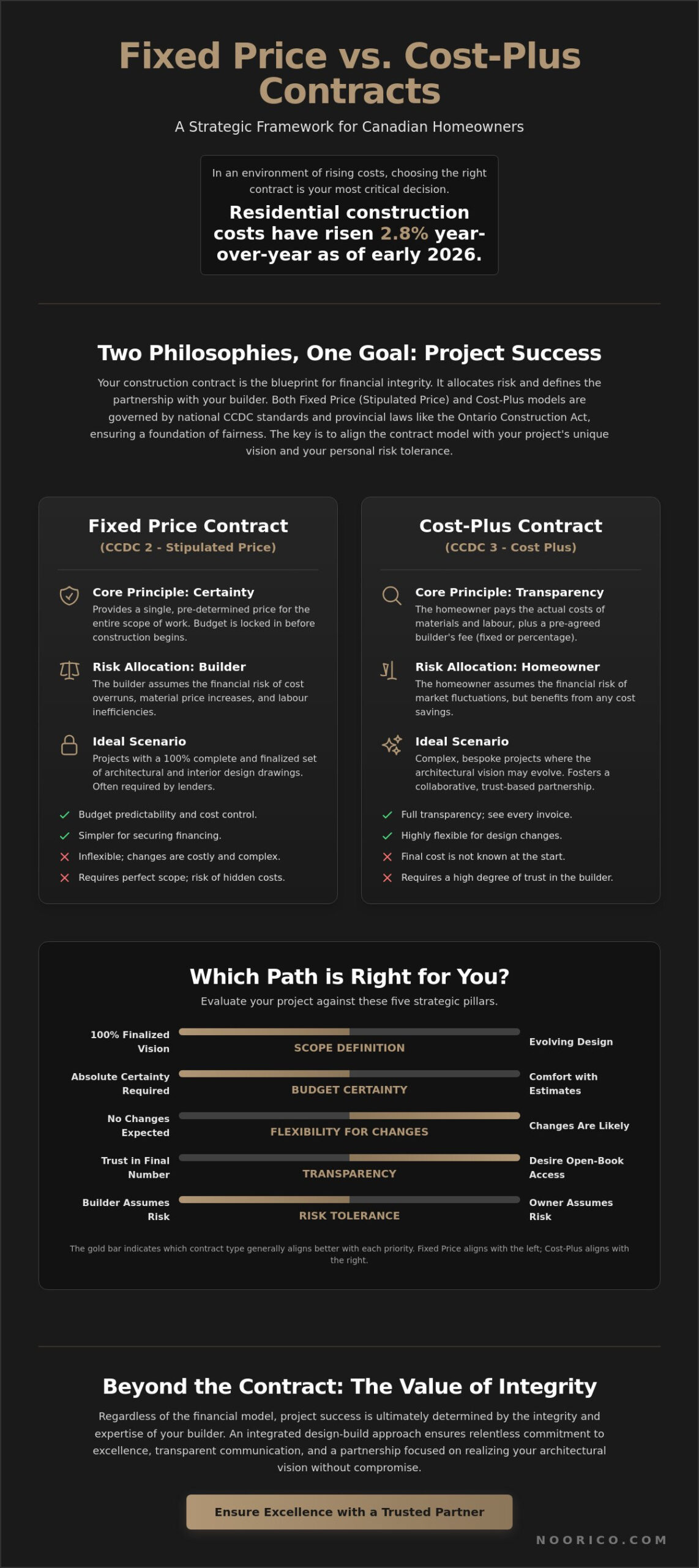
A Construction contract is far more than a legal formality; it’s the strategic blueprint for your project’s financial integrity. Once your architect has finalized the vision for your home, selecting the right agreement becomes the most critical decision you’ll make. This document serves as the primary mechanism for risk allocation, defining exactly how costs are managed and who carries the burden of market shifts. With residential construction costs rising by 2.8 percent year-over-year in early 2026, the choice between a fixed price vs cost plus construction contract canada determines how your investment is shielded from volatility.
The “Stipulated Price” philosophy prioritizes budget certainty, where the builder agrees to a set fee for a defined scope of work. In contrast, the “Cost Plus” philosophy focuses on flexibility and total transparency, where the owner pays for actual expenses plus a professional fee. Both models have their place in the Toronto GTA market, but their success depends on a clear understanding of Canadian industry standards.
The Role of CCDC Standards in Canada
The Canadian Construction Documents Committee (CCDC) provides the national standard for fair and balanced agreements. CCDC 2 is the industry benchmark for Stipulated Price contracts, while CCDC 3 governs Cost Plus arrangements. These standardized forms protect both the homeowner and the builder by using language that has been tested in Canadian courts for decades. However, distinguished residential projects often require “Supplementary Conditions.” These are custom clauses we use to tailor national standards to the unique requirements of a bespoke build, ensuring your specific architectural marvel is protected by more than just a generic template. Using these verified forms ensures that prompt payment rules and mandatory holdback releases, updated in the January 1, 2026, Ontario Construction Act amendments, are strictly followed.
The Interplay of Risk, Scope, and Price
Every project operates within the “Iron Triangle” of construction: time, cost, and quality. A change in one inevitably impacts the others. The contract model you choose shifts the weight of these factors between you and your builder. A fixed price model rewards builder efficiency, as the contractor benefits from completing the work under budget. However, it requires a perfect scope of work from the outset. A cost plus model rewards transparency and quality, allowing the vision to evolve during the build without the friction of constant change orders. It’s a relationship built on trust where the builder acts as your fiduciary, ensuring every dollar spent is visible and justified. Choosing the right path requires a relentless focus on your project’s unique complexity and your personal comfort with financial risk.
The Fixed Price (Stipulated Price) Contract: Stability and Scope
The Stipulated Price model, often referred to as a “Lump Sum” agreement, provides a singular, fixed figure for the entire project scope. This model is the bedrock of CCDC 2, a standard document maintained by the Canadian Construction Documents Committee (CCDC). It appeals to conservative budget-setters because it places the financial risk of material cost fluctuations largely on the builder. In a market where residential construction investment reached $16.4 billion in January 2026, lenders often demand this level of predictability before approving high-value mortgages. When evaluating a fixed price vs cost plus construction contract canada, the fixed model stands out as the primary choice for those who prioritize a hard ceiling on their capital expenditure.
Success with this model requires a prerequisite that cannot be overlooked: a 100 percent complete set of architectural and interior design drawings. Without exhaustive specifications, the “fixed” price becomes a moving target. Our approach to pre-construction is relentless; we believe that perfection in the planning phase prevents friction during the build. This model is distinguished by its ability to anchor a project’s cost even when global tariffs drive up the price of metals like steel and aluminum, as seen in early 2026. For homeowners who have a finalized vision and seek a stable financial path, our strategic project management is distinguished by its precision and reliability.
When Fixed Price is the Superior Choice
A fixed price agreement is the superior choice for projects where the design is fully realized and structural surprises are unlikely. It’s particularly effective for new builds on cleared land where the scope is predictable. This model simplifies the complex intersections of realty and finance by providing a static budget that aligns perfectly with bank draw schedules. It rewards builders who are masters of efficiency and supply chain management. However, it demands a disciplined homeowner who is committed to their initial choices, as the contract’s strength lies in its rigidity.
Potential Pitfalls: The Change Order Complexity
The primary danger in a fixed-price model is the “Change Order” trap. Any deviation from the original drawings, known as scope creep, leads to administrative fees and premium pricing for mid-project adjustments. If residential building construction costs continue to rise beyond the 2.8 percent year-over-year increase recorded in Q1 2026, some builders may feel pressured to cut corners to protect their margins. A low initial bid should be viewed with caution. It often signals a lack of accountability or an intention to recoup profits through aggressive change order billing once the project is underway.
The Cost-Plus Model: Flexibility for Evolving Visions
The Cost-Plus agreement represents a collaborative approach where the owner pays for the actual labour and material costs of the build, supplemented by a predetermined fee. While the fixed price model relies on rigidity, the Cost-Plus structure is designed for fluidity and total financial transparency. It’s the preferred choice for sophisticated clients who prioritize the pursuit of architectural marvels over a static initial estimate. When deciding between a fixed price vs cost plus construction contract canada, it’s essential to understand that this model operates as a fiduciary relationship. The builder acts as your professional guide, ensuring every dollar invested is visible through a “books-open” policy where you review every invoice and trade receipt.
There are two primary variations of the “Plus” in these agreements. A Fixed Fee model establishes a set dollar amount for the builder’s management services, which keeps the professional fee static regardless of material price increases. Alternatively, a Percentage of Cost model calculates the fee as a portion of the total project spend. The 2025 updates to CCDC 3 have further refined these structures to align with modern prompt payment legislation, ensuring that the flow of capital remains steady and transparent throughout the construction lifecycle.
The Advantages for High-End Bespoke Projects
Cost-Plus is the superior framework for high-end bespoke projects where excellence cannot be rushed or compromised by a pre-set budget ceiling. It allows for “on-the-fly” design refinements, enabling you to select premium finishes or adjust architectural details as the space takes shape. Our role evolves from a service provider to a Visionary Partner, working alongside your design team to achieve perfection. This model is particularly effective for major renovations of Toronto’s historic estates. It handles unforeseen structural conditions without the adversarial friction of change order negotiations, as the focus remains entirely on the best solution for the home’s integrity.
Managing the “Blank Cheque” Perception
The most common anxiety regarding Cost-Plus is the fear of an open-ended financial commitment. We mitigate this through a “Guaranteed Maximum Price” (GMP) hybrid, which provides a protective cap on the total expenditure while maintaining the transparency of a Cost-Plus model. Establishing a rigorous project management rhythm is vital. We utilize real-time expense tracking to ensure you’re never surprised by the month-end statement. Ultimately, this agreement thrives on integrity. It’s a trust-based approach where our relentless commitment to your vision ensures that the final product is not just a building, but a lasting legacy of quality and design.
Fixed Price vs. Cost-Plus: A Strategic Framework for Homeowners
The strategic choice between a fixed price vs cost plus construction contract canada is rarely about which model is “cheaper.” It’s about where you choose to place your contingency. A fixed-price agreement often includes a builder’s premium to buffer against material price spikes, while a cost-plus model reveals the raw market rate in real-time. As of April 29, 2026, the Bank of Canada has maintained its policy interest rate at 2.25 percent, providing a stable backdrop for financing. However, regional cost trends are diverging. While Toronto has seen a slight decline in overall construction costs, cities like Calgary and Edmonton have experienced increases of 4 percent or more. This volatility makes “Open Book” accounting a vital tool for the sophisticated homeowner who demands total financial accountability.
Comparative Analysis Table
| Pillar | Fixed Price (CCDC 2) | Cost-Plus (CCDC 3) | GMP (Hybrid) |
|---|---|---|---|
| Scope Definition | Rigid and finalized | Fluid and evolving | Defined with flexibility |
| Risk Bearer | Builder carries cost risk | Owner carries cost risk | Shared risk threshold |
| Flexibility | Low (Change orders required) | High (Design-as-you-go) | Moderate |
| Admin Effort | Minimal for the owner | High (Audit-intensive) | High |
While fixed price offers certainty, cost-plus offers the relentless pursuit of perfection through flexibility.
Decision Factors: Assessing Your Risk Tolerance
Selecting the right framework requires an honest assessment of your project’s maturity. You must ask yourself: is my architectural design 100 percent final, or do I intend to refine the details as the structure emerges? A fixed-price contract is an excellent tool for those with a completed vision and limited time for weekly oversight. Conversely, if you wish to act as a collaborative partner in the selection of every distinguished finish, the cost-plus model provides the necessary freedom. Our visionary project management is distinguished by its ability to guide you through these complexities with quiet confidence.
Your personal risk tolerance regarding inflation also plays a decisive role. With residential construction costs rising by 0.6 percent in the first quarter of 2026, the cost-plus model ensures you benefit immediately from any stabilization in lumber or wood product prices. Our design-build approach often harmonizes these contract tensions. By integrating realty strategy with architectural design, we create a unified path that protects your investment while shaping your future home into an architectural marvel. This integrated methodology ensures that integrity and accountability remain the pillars of our relationship, regardless of the financial model you select.
Beyond the Contract: Why Design-Build Integrity Matters
The strategic debate between a fixed price vs cost plus construction contract canada eventually leads to a singular truth: an agreement is only as robust as the integrity of the firm that executes it. At NOORICO, we operate under an ethical umbrella that integrates realty strategy, financial planning, and high-end construction. This multi-disciplinary approach ensures your investment is managed with a level of sophistication that transcends simple contract types. We don’t just provide a service; we act as a guide through the complex intersections of design and implementation. Our pursuit of architectural marvels is relentless, and we believe that the foundation of every home is the trust built between the visionary and the builder.
A contract serves as the legal skeleton of a project, but our project management expertise provides the vital systems that bring that vision to life. We recognize that your home is a significant financial asset and a deeply personal legacy. While total investment in building construction reached $23.4 billion in January 2026, the success of an individual project depends on the builder’s commitment to accountability. We’ve spent 25 years refining a trust-based approach that reassures clients their investments are in safe, principled hands.
The NOORICO Commitment to Transparency
Our project management is excellence in action. We utilize a “Who-What-Why” progression in our communication, ensuring you understand exactly who is performing a task, what is being accomplished, and why it serves the long-term value of your estate. This methodical rhythm mirrors the construction process itself, providing a predictable and reassuring flow of information. Whether you select a stipulated price or a cost-plus model, our budget reporting remains transparent and structured. With over two decades of experience in the Toronto GTA, we’ve mastered the craft of balancing practical grit with elegant design. Our longevity is a badge of local expertise, and we take deep pride in the long-lasting relationships we’ve cultivated since our inception.
Shaping Your Future: The Next Step
Choosing the right contract model is a strategic decision that depends on your specific architectural vision and risk profile. We invite you to bridge the gap between inspiration and practical implementation by discussing your project-specific needs with us. Our role is to transform your dreams into tangible assets while protecting your financial interests through principled management. We’re dedicated to a trust-based approach where your significant investment is in safe, seasoned hands. Every distinguished home begins with a conversation about values and vision.
Speak with a NOORICO expert about your custom build today. to begin the journey of shaping your future and building your legacy. We’re ready to guide you through the complexities of Canadian construction agreements to ensure your project becomes the architectural marvel you’ve envisioned.
Securing Your Investment Through Strategic Partnership
Choosing the right framework for your home is the definitive act of balancing budget certainty with architectural flexibility. You now understand how a fixed price vs cost plus construction contract canada aligns with different project stages, from finalized blueprints to evolving bespoke designs. These agreements are reinforced by the 2025 CCDC updates and the January 1, 2026, Ontario Construction Act amendments, providing a secure legal landscape for your significant capital investment. While the contract defines the rules, the builder’s character defines the result.
A contract is a vital tool, but our 25 years of established excellence is your true guarantee. Our integrated design-build and project management expertise is distinguished by a relentless commitment to integrity and accountability. We ensure that every detail of your build reflects the sophisticated elegance you expect from a premium Toronto GTA estate. We invite you to partner with NOORICO for your next architectural marvel and experience the peace of mind that comes from a trust-based relationship. Your vision is a legacy in the making, and we’re dedicated to shaping that future with precision and quiet confidence.
Frequently Asked Questions
Is a fixed price contract always safer for a homeowner?
No, a fixed price agreement isn’t inherently safer because it often contains a hidden “risk premium” within the lump sum. Builders include this buffer to protect their margins from material volatility, such as the 0.5 percent non-residential cost increase recorded in Q1 2026. If your design remains fluid, a cost-plus model often provides better value by ensuring you only pay for actual expenses without the added cost of a builder’s internal contingency fund.
Can I switch from a cost-plus to a fixed-price contract mid-project?
You can transition from cost-plus to fixed-price once the “discovery” phase of a project is complete. This is a common strategy for major renovations where structural surprises are likely during demolition. Once the site is stabilized and the scope is 100 percent defined, we can finalize a stipulated price amendment to provide budget certainty for the finishing stages of your architectural marvel.
What does “Guaranteed Maximum Price” (GMP) mean in Canadian construction?
A Guaranteed Maximum Price serves as a protective hybrid that caps your total financial exposure. It combines the transparency of cost-plus with the hard ceiling of a fixed-price agreement. If the actual costs fall below the GMP, the savings can be shared between the owner and builder; if costs exceed the cap, the builder typically absorbs the overage, provided the project scope hasn’t changed.
How do builders typically calculate their “fee” in a cost-plus arrangement?
Builders calculate their professional fee as either a fixed lump sum or a percentage of the total project cost. The percentage model is common for bespoke builds where the vision evolves, while a fixed fee provides an incentive for the builder to finish efficiently. Both structures are clearly defined in the 2025 CCDC contract updates to ensure total financial accountability and transparency from the project’s inception.
Which contract type do Canadian banks prefer for construction financing?
Canadian financial institutions generally favour the fixed price vs cost plus construction contract canada model because it provides a static budget for mortgage approvals. Lenders prefer the predictability of CCDC 2 when calculating loan-to-value ratios. While some banks accept cost-plus agreements with a GMP, they often require a higher contingency reserve, sometimes 15 to 20 percent, to mitigate the risk of potential overruns.
What happens if a builder goes over budget in a cost-plus contract?
In a standard cost-plus arrangement, the homeowner is responsible for all actual costs incurred, even if they exceed the initial estimate. This reality makes a relentless focus on real-time budget tracking essential for protecting your investment. We recommend a rigorous project management rhythm where every trade invoice is audited against the original budget to identify and address variances before they impact your total capital.
Are CCDC contracts mandatory for residential projects in Canada?
CCDC contracts are not legally mandatory, but they are the distinguished standard for professional residential construction across the country. Using these forms ensures your project remains compliant with the January 1, 2026, Ontario Construction Act updates regarding prompt payment and mandatory annual holdback releases. Custom contracts often lack the balanced risk allocation found in CCDC documents, which can lead to unnecessary legal friction.
How do change orders work differently in fixed price vs. cost-plus models?
Change orders in fixed-price models require a formal price negotiation and written approval before any new work begins. This process can sometimes slow down the construction rhythm during critical phases. In a cost-plus model, changes are handled with greater fluidity. The actual labour and material costs are simply recorded as they occur, allowing your architectural vision to evolve without the administrative friction of constant re-quoting.